UniUni Receives Notice of Breach from MAK Acquisition: What It Means for the SPAC Deal

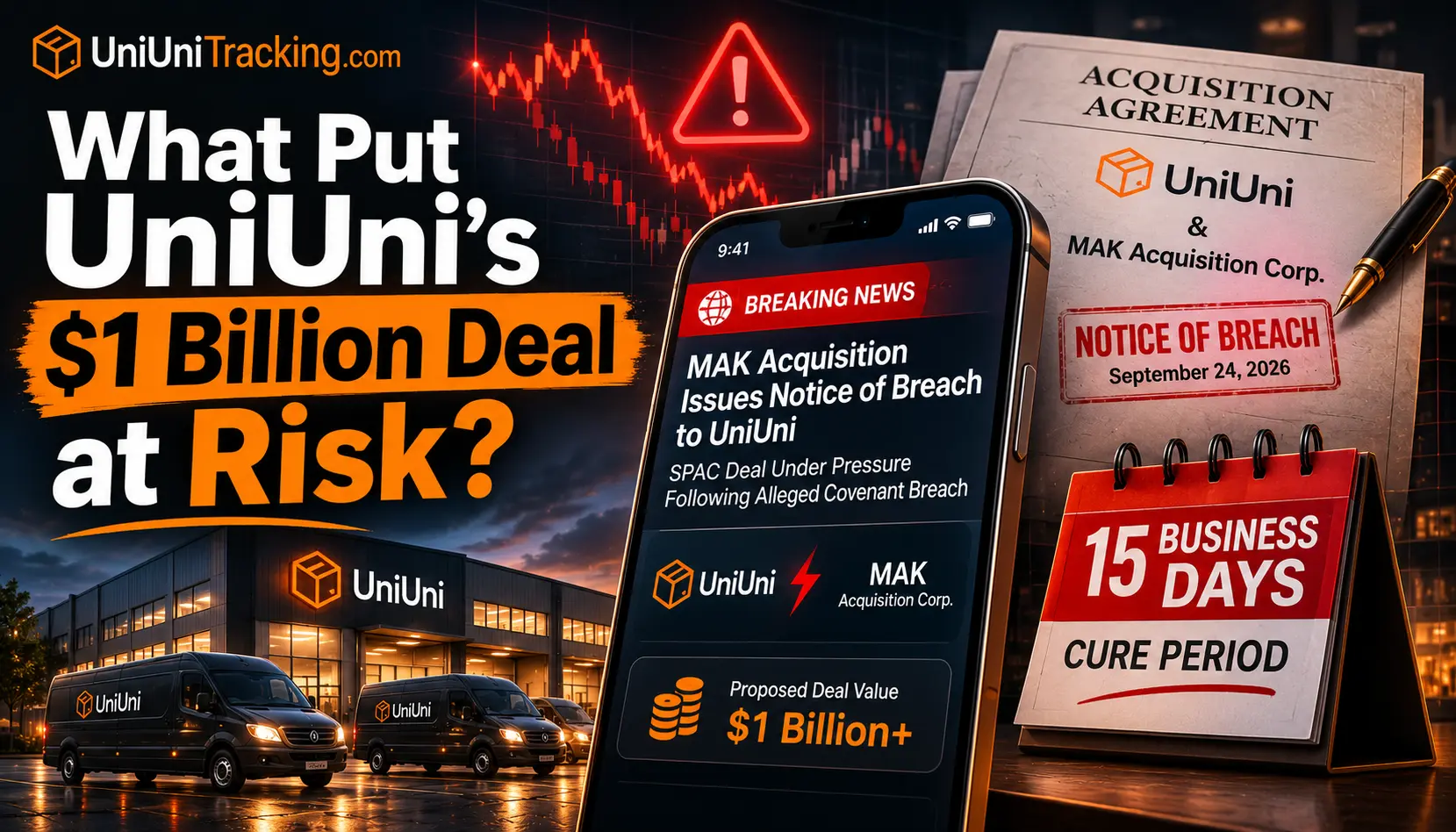
In late September 2026, MAK Acquisition Corp. delivered a formal notice of breach to UniUni (officially Uni Express Inc.). The notice put the planned reverse-takeover deal under serious pressure and raised fresh questions about UniUni’s path to the public markets.
I spent time going through the original company announcements, The Globe and Mail’s reporting by Sean Silcoff, official press releases, and related market coverage to piece together a clear picture of what actually happened, why the notice was issued, and what it meant at the time for UniUni, its investors, and the broader last-mile delivery sector.
This post focuses strictly on the September 24, 2026 notice of breach. Later developments, including the eventual termination of the agreement in October, are covered separately.
What Triggered the Notice of Breach from MAK Acquisition?
According to MAK Acquisition, UniUni had agreed in the May 15, 2026 purchase agreement to operate its business within certain specific parameters during the interim period leading up to the proposed combination. One of the key parameters was a defined maximum cumulative pre-tax loss.
MAK stated that UniUni’s business and financial performance had deteriorated since the deal was first announced. In the SPAC’s view, this deterioration constituted a material breach of the purchase agreement. The formal notice of breach was delivered on September 24, 2026.
The original reporting from The Globe and Mail provides useful context on both the notice itself and the background of the deal. You can read that coverage here:
At the time the notice was issued, neither side publicly disclosed the exact dollar amount of the cumulative pre-tax loss limit or how far UniUni had exceeded it. MAK simply described the performance as having deteriorated and the breach as material.
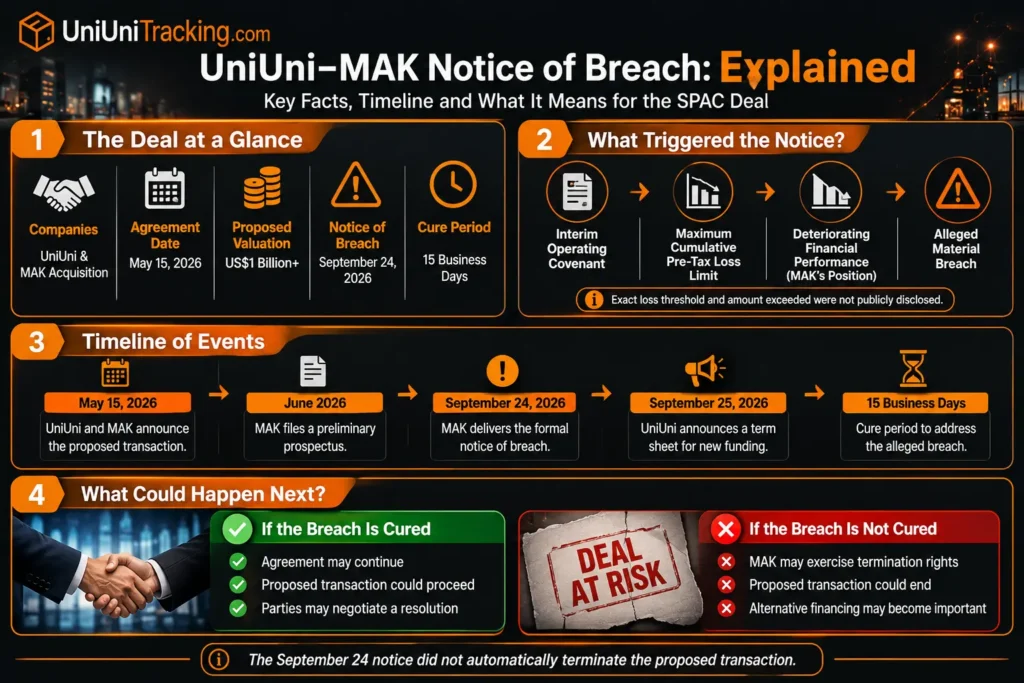
Timeline of the UniUni-MAK Acquisition Deal So Far
To understand the significance of the breach notice, it helps to place it in the broader timeline of the proposed transaction:
This timeline shows that the deal had already been in process for roughly four months when the notice arrived. The interim period between signing and closing is often the most sensitive phase in SPAC transactions, precisely because the target continues operating while the acquiring vehicle has limited control.
How Serious Is a Notice of Breach in a SPAC Transaction?
In SPAC deals, interim covenants exist to protect the special purpose acquisition company from material adverse changes in the target’s business between the signing of the purchase agreement and the closing of the transaction. When a notice of breach is issued, it is a formal step that usually triggers a contractual cure period.
In this case, UniUni had 15 business days from receipt of the notice to cure the breach. MAK made it clear in its announcement that if the issue was not resolved within that window, it intended to exercise its contractual right to terminate the purchase agreement.
It is worth noting that not every breach is automatically fatal. Some can be cured through operational adjustments, additional capital injections, or negotiated waivers. Others, particularly those involving financial metrics that have already been exceeded, can be harder or impossible to reverse. At the time of the September notice, the market did not yet know which category this particular breach would fall into.
What Happens If the Breach Is Not Cured?
If a target fails to cure a material breach within the agreed period, the SPAC typically has the right to terminate the agreement and walk away. In many cases the SPAC also reserves additional rights, which can include claims for damages or other remedies depending on the specific language of the purchase agreement. MAK explicitly reserved all of its rights in its public statements.
UniUni’s Immediate Response and Market Reaction
In the days immediately following the notice, UniUni did not issue a detailed public rebuttal of MAK’s claims. Instead, the company moved quickly on a parallel track. On September 25, 2026 — the day after the breach notice — UniUni announced that it had entered into a term sheet for a new private funding round led by an existing investor.
The company framed the funding as support for continued growth across North America and as a way to strengthen its financial position heading into the peak delivery season. Many observers interpreted the timing as a deliberate signal that UniUni was preparing for the possibility that the SPAC path might close.
On the market side, MAK’s shares saw some trading interest as investors reassessed two possible outcomes: the chance that the UniUni deal could still be salvaged, versus the likelihood that MAK would return to searching for a different qualifying acquisition target before its own deadline.
Key Takeaways for Investors and Industry Watchers
Looking back at the September 2026 notice with the benefit of the publicly available information, several points stand out:
Frequently Asked Questions
Final Thoughts
The September 24, 2026 notice of breach marked a clear turning point in the UniUni-MAK story. What had been presented months earlier as a straightforward path to a public listing suddenly became conditional and time-limited. UniUni’s decision to pursue additional private funding almost immediately afterward showed that management was not waiting passively for the cure period to play out.
For anyone following last-mile delivery companies, SPACs, or high-growth Canadian technology businesses, the episode remains a useful case study in how interim financial covenants can shape the final outcome of a proposed public-market transaction.
This post is based on publicly available reporting and company announcements from September 2026. The situation continued to develop in the following weeks.