UniUni Announces Term Sheet for New Private Funding Round Amid SPAC Uncertainty

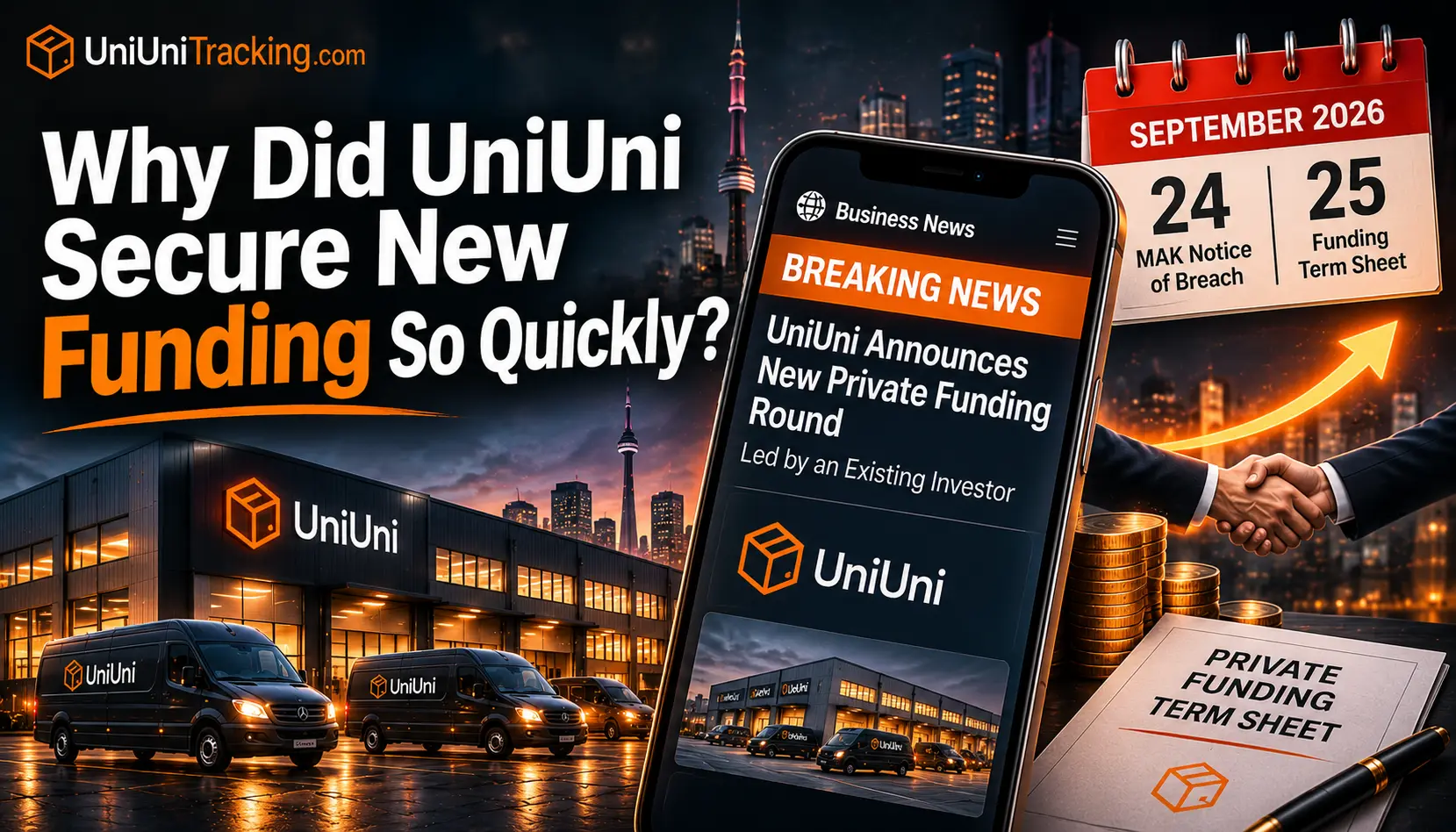
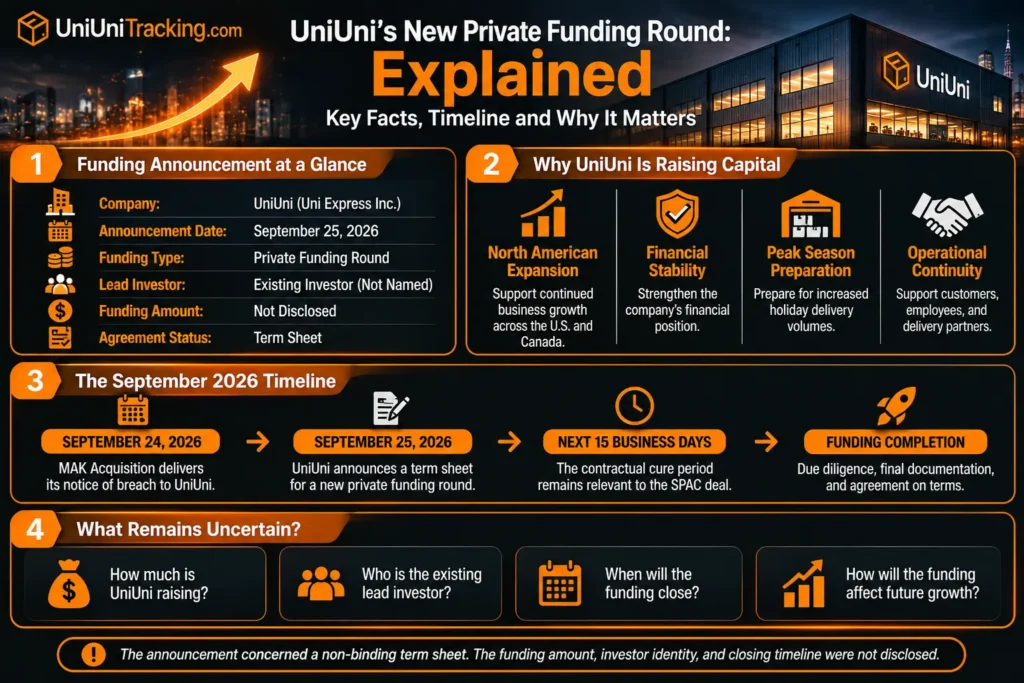
On September 25, 2026 — just one day after MAK Acquisition delivered its notice of breach — UniUni announced that it had entered into a term sheet for a new private funding round. The timing was hard to miss.
I reviewed the company’s official release, coverage from Canadian tech and business outlets, and the surrounding context of the SPAC situation to understand what this move signaled. This post walks through the details of the funding announcement, why UniUni made it when it did, and how it fit into the company’s broader position at the time.
Details of UniUni’s New Private Funding Round
In its announcement, UniUni (Uni Express Inc.) stated that it had entered into a term sheet for a new private funding round led by an existing investor. The company said the additional capital was expected to support continued growth across North America and to strengthen its financial position as it headed into the peak delivery season.
The official release did not disclose the size of the round or name the lead investor. That lack of specific dollar figures is relatively common at the term-sheet stage, when the agreement is still non-binding and final terms have not been locked in.
You can read the original company announcement here:
UniUni Announces Term Sheet for New Private Funding Round – Newswire.ca
The stated goals of the funding were straightforward:
Why UniUni Is Raising Private Capital Now
The timing of the announcement is the most interesting part of the story. MAK Acquisition had issued its notice of breach on September 24. UniUni’s funding term sheet followed on September 25. That sequence strongly suggests the company was already working on contingency options and chose to make those options public almost immediately.
Preparing for Peak Delivery Season
Last-mile delivery companies face their heaviest volumes in the final months of the year. UniUni has repeatedly pointed to its ability to scale for peak periods as a core strength of its model. Securing additional capital before that surge begins is a practical step, especially when other financing paths (in this case the SPAC) had become uncertain.
Strengthening the Balance Sheet During Uncertainty
A notice of breach creates a period of ambiguity. Until the cure window closes or the parties reach a new understanding, the outcome of the public listing path remains open. By lining up private capital, UniUni reduced its dependence on a single transaction and gave itself more room to operate while the SPAC situation played out.
CEO Peter Lu’s comment in the release emphasized continuity. He highlighted the support of existing investors and the team’s focus on reliable service during the coming peak. The language was careful — it neither confirmed nor denied that the SPAC deal was in trouble, but it made clear the company was not standing still.
How This Funding Fits Into UniUni’s Growth Story
UniUni has raised capital multiple times in recent years to support expansion across Canada and the United States. Earlier in 2026 the company had already completed a significant equity and credit facility raise. The September term sheet represented another step in that pattern rather than a sudden change in strategy.
What made this particular round different was the context. Previous raises occurred while the company was still on a clear path toward a public listing via the MAK transaction. This one arrived after that path had been publicly called into question. In that sense it served both operational and signaling purposes: it provided potential liquidity and it showed that existing backers remained willing to support the business.
For a company whose model relies on scaling warehouse capacity, driver networks, and technology infrastructure ahead of volume spikes, access to capital is not optional. The term sheet, even while still non-binding, indicated that UniUni was taking steps to keep that access open.
What Investors and Partners Should Watch Next
At the time of the announcement, several practical questions remained open:
Those questions mattered because the company was operating in a capital-intensive segment of logistics while also managing the fallout from a high-profile public-market process that had become uncertain.
Frequently Asked Questions
Final Thoughts
UniUni’s decision to announce a private funding term sheet the day after receiving a notice of breach was a clear signal of intent. The company was not prepared to wait passively while the SPAC cure period ran its course. Instead it moved to shore up its capital position and keep its growth plans on track.
Whether the eventual private round fully replaced the capital that would have come through the public listing is a separate question. What the September 25 announcement demonstrated was that UniUni still had access to investor support and was willing to use it when the public-market path became less certain.
This post draws on UniUni’s official release and contemporaneous reporting from September 2026. The broader SPAC situation continued to develop in the weeks that followed.