

UniUni Driver Pay and Safety Concerns Surface as Company Prepares for Public Markets

In late September 2026, as UniUni was still working through its proposed public listing via MAK Acquisition, a report from The Capitol Forum brought attention to concerns raised by former employees and drivers about pay practices and working conditions.
I reviewed the publicly available summary of that reporting, related class-action activity in the United States, and earlier coverage of UniUni’s labour practices to put together a factual overview. This post sticks to what has been reported by credible sources and does not attempt to adjudicate the underlying claims.
What Former Employees and Drivers Have Alleged
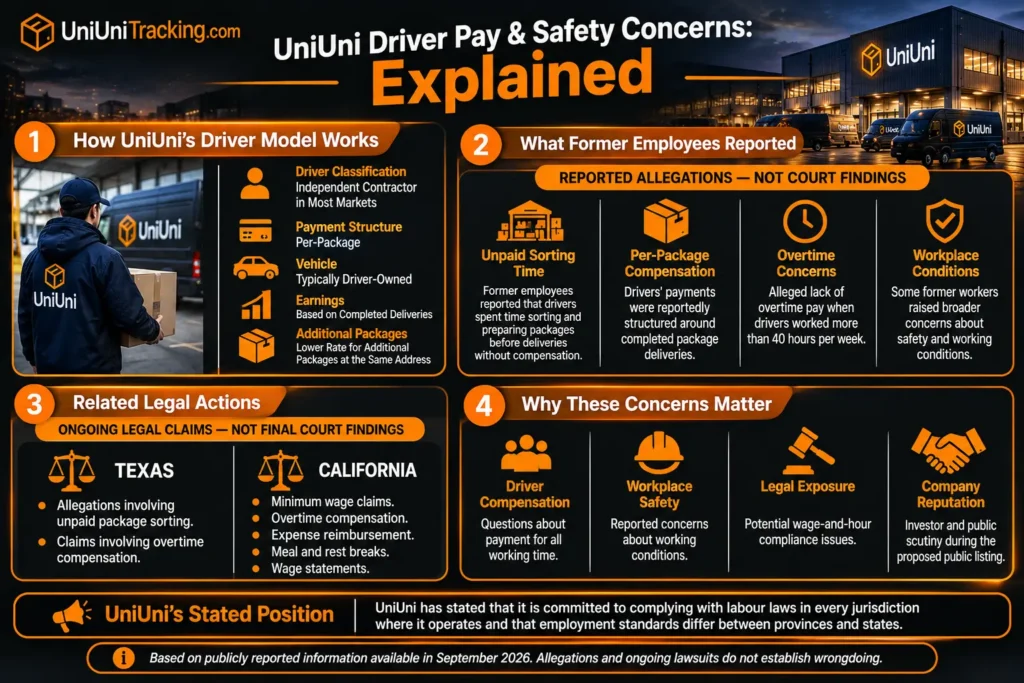
According to The Capitol Forum’s September 25, 2026 report, four former employees described a pay structure in which drivers were not compensated for time spent sorting packages before their routes began and were not paid overtime. The report framed these practices as part of how UniUni has been able to offer lower delivery prices than many traditional carriers.
The core allegations reported at the time included:
These claims were presented as the accounts of former employees. They have not been tested or resolved in court as part of the Capitol Forum reporting itself.
How UniUni’s Driver Model Works
UniUni operates a technology-enabled last-mile network that relies heavily on independent contractors and delivery service partners. Drivers typically use their own vehicles and are paid based on completed deliveries rather than an hourly rate.
Independent Contractor Structure
In most markets, UniUni drivers are classified as independent contractors. This structure is common across large segments of the gig-based delivery industry. It allows the company to scale its network quickly without carrying a large employee workforce, but it also means drivers generally do not receive traditional employee benefits or overtime protections under standard employment law.
Per-Package Pay vs. Hourly Compensation
Public descriptions of UniUni’s contractor pay model center on a per-package rate. Drivers earn a set amount for the first package delivered to a customer address and a lower amount for additional packages going to the same customer. Gross daily earnings therefore depend heavily on route density, the number of stops, and how many multi-package deliveries occur.
Because pay is tied to completed deliveries rather than hours worked, time spent sorting packages, waiting at warehouses, or dealing with route inefficiencies is not directly compensated under a pure piece-rate system. That distinction sits at the center of many of the concerns that have been raised.
Related Legal Actions Involving UniUni Drivers
Separate from the Capitol Forum report, UniUni has faced lawsuits in the United States alleging violations of wage-and-hour laws.
One case filed in Texas alleged that drivers were required to sort and organize packages before their routes without pay and that they did not receive overtime for hours worked beyond 40 in a week. Another action in California raised claims related to minimum wage, overtime, expense reimbursement, meal and rest breaks, and wage statements.
These cases are ongoing legal matters. The existence of the lawsuits does not establish that the allegations are true; it does show that questions about driver classification and compensation have moved beyond internal complaints into the court system.
For a summary of the types of claims being pursued, see this overview of related driver lawsuits:
UniUni Delivery Driver Lawsuit: Unpaid Wages & Overtime – ClassAction.org
Why These Concerns Matter for UniUni’s Growth and Reputation
Last-mile delivery is a low-margin, high-volume business. Companies that can keep unit costs down often gain share with price-sensitive e-commerce merchants. UniUni’s rapid growth has been built in part on an efficient, asset-light model that relies on contractor drivers and technology to move large numbers of parcels at competitive rates.
At the same time, labour practices in the gig and contractor delivery sector have come under increasing scrutiny in both Canada and the United States. Regulators, courts, and lawmakers continue to examine where the line sits between independent contracting and employment. Companies that scale quickly using contractor models can face legal and reputational risk if their practices are later found to fall short of applicable wage-and-hour rules.
For UniUni, these issues surfaced at a particularly sensitive moment — while the company was still pursuing a public listing. Public-market investors tend to look closely at contingent liabilities, ongoing litigation, and potential regulatory exposure. Even unresolved claims can affect how a company is valued and how its story is received.
What UniUni Has Said in Response
In earlier coverage of labour-related questions, UniUni has stated that it is fully committed to complying with all labour laws in every jurisdiction where it operates. The company has also noted that employment standards differ from province to province and state to state.
At the time of the September 2026 Capitol Forum report, UniUni did not issue a detailed public rebuttal of the specific former-employee accounts in that piece. As with many companies facing similar allegations, the formal responses have tended to appear in court filings rather than in press statements.
Frequently Asked Questions
Final Thoughts
The reports and lawsuits that surfaced around UniUni’s driver practices highlight a tension that many fast-growing last-mile companies face. The same operating model that enables rapid expansion and competitive pricing can also generate legal and reputational questions about how workers are classified and compensated.
As of the public reporting available in September 2026, these matters remained unresolved. They formed part of the broader backdrop against which UniUni was navigating both its SPAC process and its private funding efforts.
This post is based on publicly reported information from The Capitol Forum, class-action summaries, and earlier business coverage. It does not take a position on the ultimate merits of any claim.