
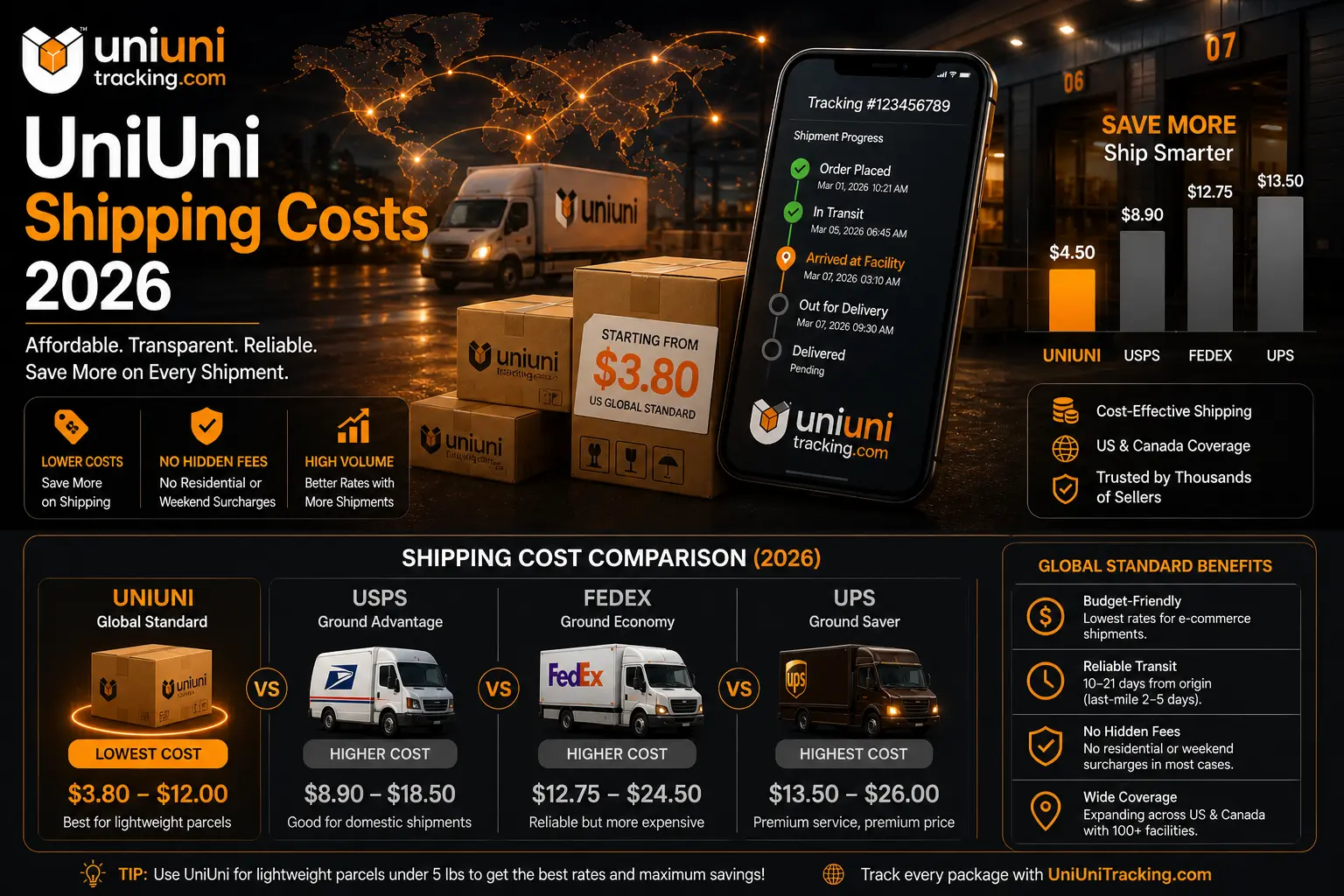
UniUni Shipping Costs & Rates 2026: Full Guide to Pricing, Fees, and Global Delivery Standards

Shipping costs have been climbing steadily, squeezing margins for small e-commerce sellers and frustrating online shoppers who expect “free shipping” that somehow still impacts the final price. If you’ve been looking for a more affordable way to move lightweight parcels across the US and Canada, you’ve likely come across UniUni.
UniUni is a technology-driven last-mile delivery service specializing in affordable, on-demand shipping for e-commerce. It partners with sellers (especially those moving high volumes of small packages from platforms like Shein, Temu, AliExpress, or independent Shopify stores) to handle the final stretch from sorting hubs to the customer’s door.
In this guide, we break down UniUni shipping costs in detail for 2026, explain exactly what Global Standard shipping means, compare rates and options, and share practical tips to help you decide if it’s the right fit. Whether you’re a seller trying to protect your margins or a buyer curious about the service behind your order, you’ll get a clear, transparent picture of what to expect.
Why UniUni Shipping Costs Matter in 2026?
With major carriers like UPS, FedEx, and even USPS implementing rate increases, many businesses are feeling the pressure. A single small parcel that cost $8–$10 a couple of years ago can now easily push past $12–$15, especially during peak seasons. For sellers offering free or low-cost shipping to stay competitive, those extra dollars add up fast and eat into profits.
This is where UniUni stands out. The company has built its model around lightweight parcels (typically under 10 lbs) with aggressive, transparent pricing and no surprise residential or weekend surcharges in many cases. For high-volume shippers, this can translate into meaningful savings that help keep prices attractive for customers while preserving margins.
In 2026, with continued e-commerce growth and expansion of UniUni’s network in both the US and Canada (including improved cross-border capabilities), understanding these costs has never been more important. The right shipping partner can be the difference between healthy profits and constantly fighting rising expenses.
What is UniUni Global Standard Shipping?
UniUni Global Standard is the carrier’s primary budget-friendly service level, designed as the default option for most e-commerce orders, especially those promising “free shipping.” It prioritizes cost efficiency over speed, making it ideal for non-urgent deliveries.
It typically handles the last-mile portion after international or long-haul transit, focusing on reliable door-to-door delivery within its coverage areas. UniUni emphasizes transparent pricing, real-time tracking, and a network of flexible drivers to keep costs low while scaling with demand.
Global Standard vs Expedited – Key Differences
Feature | Global Standard | Global Expedited |
|---|---|---|
Best For | Cost-sensitive, standard orders | Time-sensitive deliveries |
Transit Time (last-mile) | 2–5 days | 1–3 days |
Overall ETA (from origin) | 10–21 days | 7–14 days |
Cost | Lowest rates | Higher (premium for speed) |
Duties | DDP (prepaid where applicable) | Faster clearance |
Global Standard works well for the majority of lightweight e-commerce parcels, where customers are okay waiting a bit longer for the best price. “Expedited” is the upgrade path when speed matters more than cost.
Who Should Use UniUni Global Standard?
UniUni Shipping Costs Breakdown 2026
Understanding the actual numbers is the best way to decide whether UniUni fits your budget. In 2026, UniUni continues to position itself as one of the most competitive options for lightweight e-commerce parcels, especially those under 5 lbs.
Rates remain quote-based and vary by weight, zone, volume, and service level, but they generally stay significantly lower than traditional carriers for small packages. This makes the service particularly attractive for sellers moving high volumes of clothing, accessories, and other light goods.
How UniUni Shipping Costs Are Calculated?
UniUni calculates costs primarily based on:
The system uses a combination of package dimensions (L x W x H) and weight to determine the billable weight. This helps prevent oversized lightweight boxes from costing the same as dense ones. For most e-commerce orders, the final rate appears at checkout or through a business quote.
Transparent pricing is a core promise. UniUni emphasizes zero surprise surcharges for residential delivery in many cases, which is a big advantage over carriers that add extra fees.
Current UniUni Rates by Package Weight (2026)
Here are approximate ranges for Global Standard service based on current data:
Weight | Canada (CAD) | U.S. (USD) | Best For |
|---|---|---|---|
< 1 lb | $4.50 – $6.00 | $3.80 – $5.50 | Accessories, small items |
1 – 3 lb | $6.00 – $8.50 | $5.50 – $7.50 | Typical Shein/Temu orders |
3 – 5 lb | $8.50 – $12.00 | $7.50 – $10.00 | Clothing bundles |
Notes: Rates are averages and can be lower with volume discounts or in high-density zones. Always request a custom quote for precise pricing.
UniUni Shipping Cost Examples for Real Sellers
These real-world examples show why many resellers and DTC brands are turning to UniUni for cost predictability.
Volume Discounts and Pricing Tiers
The real savings kick in at scale. Shippers moving 100+ parcels per day unlock tiered discounts that can reduce rates by 20–40%. UniUni’s model rewards consistent volume with better pricing, making it especially powerful for growing e-commerce operations.
Even mid-volume sellers (50+ parcels/day) can negotiate improved rates by reaching out directly. The company’s high daily package volume (over 1 million in some reports) allows them to pass efficiency gains back to partners.
Factors That Affect Your UniUni Rates
Several variables influence the final price you pay. Knowing these helps you optimize shipments and avoid unexpected costs.
Dimensional Weight, Distance & Zones
UniUni, like most carriers, uses dimensional (dim) weight calculations. A large but light box can cost more than a small heavy one. Shipping across zones (e.g., coast-to-coast) also increases rates compared to local or regional deliveries.
Keeping packages compact and dense is one of the easiest ways to control costs.
Fuel Surcharges, Peak Season Fees & Hidden Costs
One of UniUni’s biggest selling points is transparent pricing with minimal or zero surprise surcharges. Unlike many competitors, they often waive or absorb peak season and residential delivery fees for standard service. However, rates can still fluctuate slightly with fuel prices or during extreme holiday surges.
Always review the full quote before confirming large shipments.
Cross-Border US-Canada Shipping Costs
UniUni has expanded its direct US-to-Canada service significantly. For parcels under $2,500, they offer streamlined customs clearance through their integrated network, reducing handoffs and potential delays.
Cross-border rates are competitive but generally higher than domestic due to additional processing. Expect costs to align closer to the upper end of standard ranges, with Global Standard remaining the most economical choice for non-urgent orders.
UniUni Shipping Costs vs Major Carriers
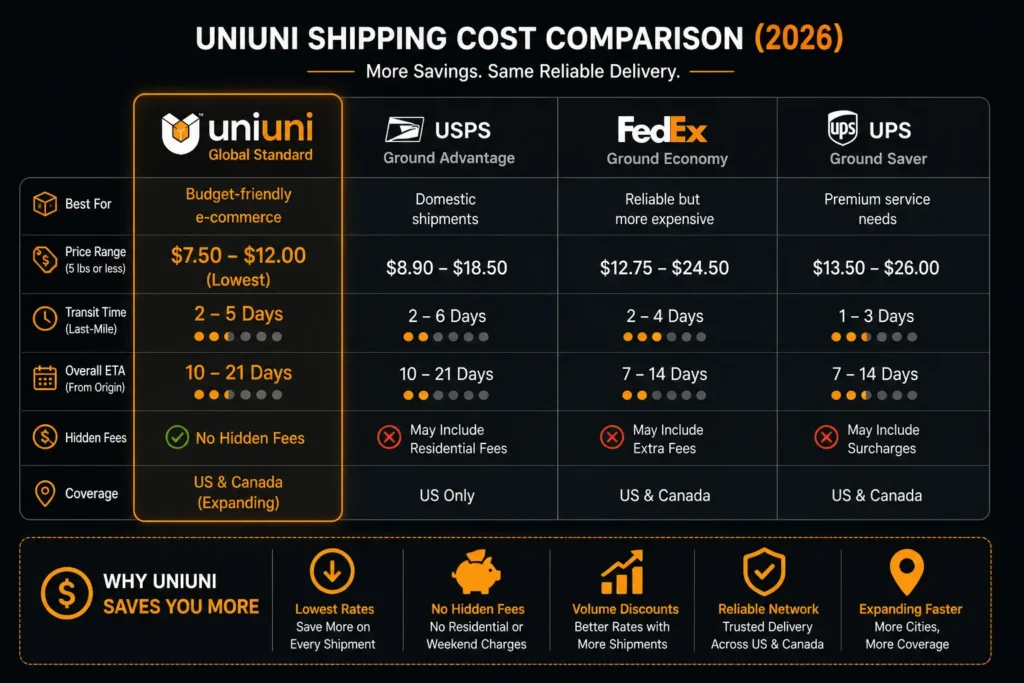
When choosing a shipping partner, price is rarely the only factor: reliability, speed, and hidden fees all matter. UniUni has carved out a strong position in 2026 by focusing on lightweight e-commerce parcels, often delivering significant savings compared to traditional carriers for small packages.
For sellers shipping hundreds of low-weight items monthly, the difference can mean thousands of dollars in annual savings. However, these savings sometimes come with trade-offs in consistency and customer experience.
UniUni vs USPS, FedEx, UPS, and Canada Post
Here’s a realistic side-by-side comparison for a typical 2 lb lightweight parcel (Global Standard / equivalent economy service) in 2026:
Carrier | Approx. Cost (USD) | Transit Time (Last-Mile) | Residential Delivery | Key Strengths | Main Drawbacks |
|---|---|---|---|---|---|
UniUni Global Standard | $5.50 – $7.50 | 2–5 days | Usually included | Lowest cost, transparent pricing | Variable reliability, gig-driver model |
USPS Ground Advantage | $8 – $12 | 2–7 days | Included | Widely available, good tracking | Slower in rural areas, rate hikes |
FedEx Ground | $10 – $15+ | 1–5 days | Extra fees often apply | Reliable & fast | Higher cost, surcharges |
UPS Ground | $9.50 – $14 | 1–5 days | Extra fees often apply | Strong network | Expensive for light parcels |
Canada Post | $9 – $13 CAD | 2–6 days | Included | Good coverage in Canada | Higher than UniUni, occasional delays |
Notes: Costs are approximate averages for domestic/regional shipments. High-volume discounts can lower UniUni rates further. Always get live quotes, as actual pricing depends on zone, dimensions, and volume.
UniUni consistently wins on pure cost for parcels under 5 lbs, especially when offering “free shipping” to customers. Traditional carriers remain stronger for heavier items or when rock-solid reliability is non-negotiable.
Pros and Cons of UniUni Shipping in 2026
Like any shipping service, UniUni has clear strengths and weaknesses. Here’s an honest assessment based on real user feedback and industry data.
Pros:
Cons:
Overall, UniUni shines when cost savings are the top priority and you’re shipping non-urgent, lightweight items in well-covered urban/suburban zones. It may not be the best choice for high-value goods or customers who demand premium service.
How to Get the Lowest UniUni Shipping Rates?
Saving money on shipping doesn’t have to feel like guesswork. With the right approach, many sellers cut their per-package costs significantly while maintaining decent delivery performance. Here’s how to make UniUni work hardest for your budget in 2026.
Visit the official portal
Head to uniuni.com/get-a-quote and fill in your details.
Provide accurate shipment data
Enter package dimensions, weight, origin, and destination ZIP/postal codes.
Specify volume
Mention your average daily or weekly shipment count for better pricing.
Compare service levels
Test both Global Standard and Expedited to see the real difference.
Contact sales for volume deals
For 50+ parcels/day, reach out directly for custom rates.
This process usually takes just a few minutes and gives you transparent pricing without hidden surprises.
Packaging Tips to Reduce Costs
Dimensional weight is one of the biggest cost drivers. A fluffy, oversized box can cost far more than a compact, denser one even if it weighs the same.
Small changes like switching from a 12x9x6 box to a 10x8x4 one can drop you into a lower rate tier. Test a few shipments to see the real impact on your bottom line.
Best Practices for High-Volume Sellers
If you ship 100+ packages daily, you’re in the sweet spot for meaningful discounts (often 20–40% off standard rates).
Many growing e-commerce brands report 15–30% overall shipping cost reductions after switching a portion of their volume to UniUni while keeping traditional carriers for heavier or urgent items.
Real User Experiences with UniUni Costs and Delivery
Real feedback paints a mixed but informative picture. On the positive side, many sellers love the pricing. One small business owner shared: “UniUni’s per-pound rate for sub-1-lb items is $1.10 after discount, while UPS wanted $2.80. My margins thank me daily.”
Shoppers and resellers frequently highlight how affordable rates enable “free shipping” offers that actually work. Cross-border US-Canada shipments also get praise for competitive pricing and smoother customs handling in many cases.
However, delivery experiences vary. Some customers report smooth, on-time arrivals with clear photo proof. Others mention frustration with packages left in unsafe spots, missed delivery attempts, or delays on Global Standard service. Trustpilot reviews average around 1.2/5, with common themes of inconsistency in the gig-driver last-mile handoff.
The takeaway? UniUni delivers strong value on cost for the right use case (lightweight, non-urgent e-commerce in covered areas), but success often depends on your volume, location, and customer expectations. Testing with a small batch of shipments is the smartest way to see how it performs for your specific needs.
Frequently Asked Questions
Conclusion
UniUni Shipping Costs in 2026 remain one of the most competitive options for e-commerce sellers moving lightweight parcels across the US and Canada. With transparent Global Standard rates often well below traditional carriers, it gives businesses a real chance to offer attractive shipping while protecting margins.
That said, success depends on using it for the right shipments: lightweight, non-urgent orders in well-covered areas, ideally at decent volume. The savings are real, but the service works best when you understand the trade-offs in consistency.