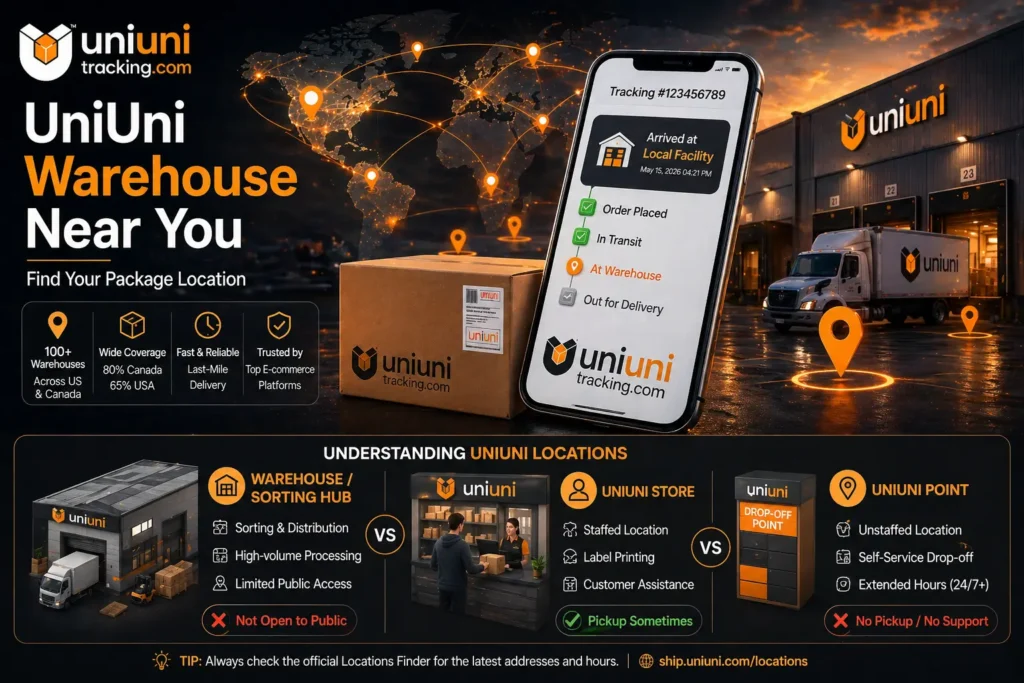
UniUni Warehouse Locations in Canada & the US —Find Your Nearest Hub for Seamless Shipping
Think of your package as a road tripper who’s almost home. It cleared customs, crossed the country, and now sits in a UniUni warehouse somewhere near you, maybe 20 minutes away, maybe two hours. The difference between that package arriving tomorrow and disappearing for a week often comes down to one thing: figuring out exactly which warehouse has it and what to do next.
We’re an independent fan site, not affiliated with UniUni. But we’ve spent months mapping their network, digging through routing data, user reports, support threads, and official announcements so you don’t have to. What you’ll find on this page is the most complete, up-to-date guide to UniUni warehouse locations across Canada and the United States in 2026: addresses, hours, pickup steps, city-by-city breakdowns, and the honest truth about where the network still has gaps.
Before you read any further, enter your tracking number in our tool below. It’ll tell you right now which UniUni warehouse has your package and what status it’s in.
Because even drivers use our tool to stay ahead.
Disclaimer: This is an independent fan site and is not affiliated with, endorsed by, or officially connected to UniUni in any way. All location information is compiled from public sources, user-reported data, job listings, and carrier routing records. For official support, visit uniuni.com/support.
What’s New at UniUni in 2026?
If you last checked this page in 2025, the network has changed more than you might expect. Here’s a fast scan of the biggest updates before we get into the full location breakdown:
- 💰 $285M total funding secured — UniUni closed a fresh $85M round in March 2026 (led by Rockets Capital + RBC credit facility), bringing total raised to $285M; read more here. The capital is going directly into robotic sorting machines across the warehouse network.
- 🌎 500+ cities, 80% Canada, 65% US — The network has grown significantly since late 2024. More cities, more drivers (100,000+ registered), more than 1 million packages processed daily.
- 🤖 99.99% robotic sorting accuracy — In partnership with Global Robotics Services (GRS), UniUni deployed AI-powered sortation across its hubs in 2025. Fewer misrouted packages, faster sort times, better tracking accuracy.
- 🇺🇸🇨🇦 Cross-Border service launched — Since July 2025, UniUni now handles US-to-Canada delivery end-to-end; no third-party handoffs and no customs friction for parcels under $2,500.
- 📦 UniUni Point is live — Automated, unstaffed drop-off locations designed for small business shippers. More on this below.
- 📉 US de minimis tariff ended — The US eliminated the $800 duty-free exemption for Chinese goods in 2025. This has shifted more Temu and Shein volume through US-based UniUni warehouses rather than direct air freight from China.
- 👔 New CTO appointed — Ali Irturk joined as Chief Technology & Product Officer in March 2026, with warehouse automation and AI routing listed as his primary mandates.
What Is a UniUni Warehouse, Exactly?
A UniUni warehouse is a last-mile sorting hub, not a storage facility, not a retail center, and definitely not the kind of warehouse you picture when you imagine forklifts and towering shelves. It’s a high-speed throughput operation where thousands of parcels arrive overnight in bulk trailers, get scanned and sorted by postal code, and leave again before most people have had their morning coffee. Your package isn’t sitting on a shelf collecting dust. It’s moving, or it’s supposed to be.
Here’s the simple version: a seller ships your order (often from China via bulk air freight), it clears customs, arrives at a UniUni hub, gets sorted onto a driver’s route, and a gig contractor in a personal vehicle drops it at your door. The whole last-mile leg, from hub to doorstep, is what UniUni built its business around. They don’t own fleets of trucks. They don’t employ unionized drivers. Instead, they run a logistics marketplace: independent contractors pick up pre-sorted batches, follow AI-optimized routes, and snap a proof-of-delivery photo at your door. It’s lean, it’s fast in urban areas, and it’s considerably cheaper for sellers than traditional carriers; which is exactly why Shein, Temu, AliExpress, and YesStyle all route their North American last-mile volume through UniUni.
Since their 2025 partnership with Global Robotics Services, UniUni’s sort floors now use AI-powered machines that achieve 99.99% sorting accuracy. That’s a meaningful upgrade from the manual sorting era that generated many of the misrouting complaints you’ll still find on Reddit and Trustpilot. The robots handle the two most labor-intensive stages, parcel sorting and sequencing, so drivers can load faster, routes get tighter, and your tracking updates more reliably.
One thing worth clearing up while we’re here: if your tracking update says “Package Received at Uni Data Center”,that’s the same thing as a UniUni warehouse. It’s UniUni’s internal label for their sorting and scanning facilities. It is not a technology data center. It doesn’t mean your package has been flagged or rerouted to some mysterious server farm. It simply means it’s arrived at a local UniUni hub and is being prepared for the next leg of its journey.
How UniUni’s Warehouse Network Works? The Big Picture
Picture a hub-and-spoke wheel, the kind you’d see on a bicycle. The center hub is UniUni’s headquarters in Richmond, BC, just ten minutes from Vancouver International Airport. That location isn’t accidental. YVR is one of Canada’s primary customs clearance points for goods arriving from Asia, which means international parcels, the ones you ordered from Temu at midnight, can clear customs and hit UniUni’s sort floor before you’ve even woken up the next morning. From Richmond, packages radiate outward to regional hubs across Canada and the US, and from those hubs, gig drivers fan out to individual doorsteps.
The journey a typical package takes looks something like this: a seller in Shenzhen ships your order via bulk air freight (often through SF Express or YunExpress), it lands in Canada or the US, clears customs, and gets transferred to UniUni. At the regional hub, it’s scanned, sorted by postal or ZIP code, and placed into a driver’s pre-loaded route batch. A contractor picks up that batch, sometimes 60 to 100 stops, and works through it based on AI-optimized directions that minimize left turns, idle time, and backtracking. When they reach your address, they snap a photo as proof of delivery, and the system auto-updates your tracking. On a good day in a dense urban area, this entire last-mile leg takes hours, not days.
The key thing to understand is that not every hub behaves the same way. UniUni’s Canadian network is what the company calls “mature”; it’s been operating for several years, driver density is high, and urban coverage in cities like Toronto, Vancouver, and Calgary is genuinely impressive. The US network is a different story. As of 2026, UniUni covers 65% of the US population, up from just 30% two years ago, but growth has been uneven. Some US hubs, like Fontana in California, operate at full capacity with thousands of packages moving daily. Others, like the Chicago hub, are still developing the driver density and route optimization that makes the Canadian network hum. That gap is what explains why a Temu order can arrive in Toronto in 24 hours while the same order takes four days to reach someone in suburban Illinois.
As of early 2026, UniUni’s network spans 100+ warehouses and sorting centers, 500+ cities, and 100,000+ registered drivers, processing over one million packages every single day. The $85M raised in March 2026 is earmarked specifically for deploying more robotic sorting machines across the expanding US warehouse network, which should close some of that Canada-US reliability gap over the coming months. And with the new cross-border service launched in July 2025, UniUni now handles the full US-to-Canada journey under one roof: first-mile US pickup, customs clearance, and final Canadian delivery; no handoffs, no third-party carriers, and no mystery gaps in tracking.
UniUni Warehouse Locations in Canada — Full 2026 List
Canada is where UniUni grew up. The company was born in Richmond, BC, scaled its model across the Greater Toronto and Vancouver areas, and spent years building the dense driver network that now covers 80% of Canadian households. If you’re in a major Canadian city, there’s almost certainly a UniUni hub within 30 minutes of your front door, and there’s a good chance your package is already there. Here’s the full breakdown, starting with what we know for certain.
City / Region | Address / Area | Hours |
|---|---|---|
Richmond, BC (HQ) | 100-10851 Shellbridge Way, V6X 2W8 | Mon–Sat 11am–6pm |
Burnaby, BC | 7481 North Fraser Way | Mon–Sat 10am–6pm |
Mississauga, ON | ~895 Meyerside Dr area | Confirm via support |
Hamilton, ON | Hub confirmed — area known | Business hours |
London, ON | Hub confirmed | Business hours |
Winnipeg, MB | 344 Saulteaux Crescent | Mon–Fri 10am–6pm, Sat 11am–5pm |
Calgary, AB | Hub confirmed — area known | Confirm via support |
Edmonton, AB | Hub confirmed | Confirm via support |
Montreal, QC | ~8648 Bd Pie-IX, Saint-Léonard | Confirm via support |
Halifax, NS | Hub confirmed | Confirm via support |
A note on addresses marked “confirm via support”: UniUni doesn’t publish a full public warehouse directory, which is frustrating but deliberate; high-volume sort facilities aren’t set up for walk-in visitors. The addresses above are compiled from job listings, user-reported pickup experiences, Google Street View confirmations, and routing data. Before showing up anywhere, call the regional line or submit a support ticket with your tracking number. They’ll confirm whether your package is physically at that location.
British Columbia — UniUni’s Home Base
Ten minutes from Vancouver International Airport, surrounded by industrial parks and ocean-bound freight corridors, sits the building where UniUni turned a food delivery startup into a logistics company processing a million packages a day. The Richmond headquarters at 100-10851 Shellbridge Way is more than a corporate address; it’s the nerve center of the entire North American network. International parcels from China land at YVR, clear Canadian customs, and roll directly onto Richmond’s sort floor. By sunrise, they’re already on a driver’s route.
If your tracking shows “Arrived at Richmond” or “Package Received at Uni Data Center—Richmond”, your order is in the best possible position. Richmond’s proximity to customs and its status as the primary hub means packages move through here faster than anywhere else in the network. One user on X posted a photo of the facility at dawn—glass facade, UniUni-branded vans lined up in rows, and sort equipment visible through the loading bays—and captioned it, “Looks like Amazon’s little brother. Wish the delivery matched the vibe.” In most Vancouver cases, it does.
The Burnaby hub at 7481 North Fraser Way handles overflow from Richmond and serves as the secondary BC distribution point. Together, the two facilities give the Greater Vancouver Area some of UniUni’s fastest delivery performance on the continent; same-day drops are genuinely common in dense neighborhoods like Metrotown, New Westminster, and Surrey. If you’re in the GVA and your package hit either facility before noon, there’s a reasonable chance it’s at your door before dinner.
For BC residents outside the Lower Mainland, Victoria, Kelowna, and Prince George, coverage thins out quickly. Packages typically complete their journey via Canada Post once they leave the GVA hub network. Your tracking will reflect this handoff as a carrier transfer, which can feel alarming but is normal.
Ontario — UniUni’s Busiest Canadian Province
Imagine a sorting floor the size of a football field at 3am, fluorescent lights humming, and conveyor belts moving parcels like a highway at rush hour. That’s a reasonable picture of what UniUni’s Mississauga hub looks like on a peak night. The GTA is UniUni’s highest-volume market in Canada, with millions of Temu, Shein, and AliExpress orders flowing into Greater Toronto every month—andMississauga is the warehouse that processes most of them.
The confirmed operational area is around 895 Meyerside Drive, though exact addresses in Mississauga aren’t publicly listed and may have expanded with new facilities. What we do know: when your tracking says “Arrived at Mississauga Hub,” your package is being sorted for delivery across the GTA: Brampton, Etobicoke, North York, Scarborough, and surrounding suburbs. From Mississauga to most GTA front doors, the typical window is one to two business days. Drivers pick up their batches early morning, and dense neighborhoods can see delivery attempts before noon.
The Hamilton hub serves as a key secondary node for the western GTA corridor and surrounding communities: Burlington, Oakville, and parts of Niagara. London, ON, handles the southwestern pocket of the province, covering London itself along with communities like Kitchener-Waterloo, Windsor, and Chatham-Kent. Both hubs are operationally confirmed through job listings and user pickup accounts, though neither publishes a street address for public use. One user in London summed up the self-pickup experience neatly: “Showed up with my ID and tracking number screenshot, out in five minutes. Saved myself a full week of waiting.”
A word for Ontario residents outside these corridors: Northern Ontario, in particular, sits well outside UniUni’s direct delivery zone. If you’re in Thunder Bay, Sudbury, or anywhere north of the 400-series highways, your package will almost certainly transfer to Canada Post for final delivery. That transfer isn’t a failure. It’s the system working as intended. However, it does add time and creates a gap in tracking updates while the handoff is processed.
Manitoba — Winnipeg’s Reliable Hub
Winnipeg punches above its weight in UniUni’s Canadian network. The 344 Saulteaux Crescent location is one of the few Canadian hubs with fully confirmed hours (Monday–Friday 10am–6pm, Saturday 11am–5pm) and a consistent track record of self-pickup availability, which makes it more accessible than most. If you’re in Winnipeg and your package has entered “Storage” status, this is where it is, and calling during business hours will get you a direct answer faster than the chatbot will.
Urban Winnipeg delivery is generally reliable within the network’s standards. Most packages reach city addresses within two to three business days of arriving at the hub. Rural Manitoba is a different equation. Communities more than 60 to 90 minutes outside the city regularly see packages handed off to Canada Post, and tracking updates can stall during that transition. If you’re in Brandon, Steinbach, or further north, build in extra time and don’t panic if the status freezes for 24 to 48 hours.
Alberta — Calgary and Edmonton
Alberta’s two major hubs mirror the province’s geography: Calgary serves the south, Edmonton serves the north, and the communities between them: Red Deer,Lethbridge, and, Medicine Ha—falll into a coverage patchwork that depends on driver availability and route density on any given day.
Our research indicates that Calgary generates the second-highest search demand of any Canadian city. The hub is operationally confirmed through routing data and job listings, though the street address isn’t publicly posted. If your tracking shows a Calgary facility scan and you’re trying to arrange a pickup or reattempt, the Canada Central/Eastern/Atlantic support line (647-360-4178) is your most direct route to a human. Edmonton follows the same pattern: confirmed hub, no public street address, and call-ahead essential before visiting.
Quebec — Montreal and the French-Language Experience
Montreal’s operations are centered around the Saint-Léonard area, with confirmed activity near 8648 Bd Pie-IX. It’s UniUni’s gateway for Quebec’s enormous e-commerce appetite. The province is one of the fastest-growing Temu and Shein markets in Canada, and Montreal sits at the center of that demand.
One thing worth knowing if you’re tracking a package in Quebec: UniUni’s official tracking system and our homepage tracking tool do not always render French-language status updates, which can create confusion. Third-party tools like ParcelsApp handle bilingual status translation better than the official UniUni tracker for suivi UniUni purposes. As one forum user noted: “UniUni suivi was a mess officially, but ParcelsApp cleared it up in seconds.”
Atlantic Canada — Halifax and the Eastern Frontier
Halifax represents UniUni’s furthest eastern reach in Canada. The hub is operationally confirmed through routing patterns and driver reports, though like most Atlantic operations, it’s lighter in both volume and driver density than the core Ontario and BC hubs. Urban Halifax: the peninsula, Dartmouth, and Bedford generally fall within serviceable delivery range. Rural Nova Scotia, New Brunswick, PEI, and Newfoundland sit largely outside UniUni’s direct delivery footprint and are handled through Canada Post partnerships.
If you’re in Halifax and your package enters “Storage” status, don’t wait. The 7-day hold window (more on that in detail below) applies here just as it does everywhere else, and reaching the Atlantic support line proactively is significantly more effective than waiting for an automated redelivery attempt that may not come.
UniUni Warehouse Locations in the US — 2026 Expansion Map
The United States is UniUni’s most ambitious project and its most complicated one. In Canada, the network took years to build, and it shows dense, reliable, and well-understood by drivers and customers alike. In the US, UniUni has done in two years what took Canada five. Coverage jumped from 30% of American households in 2023 to 65% as of early 2026, powered by hundreds of millions in venture funding and a deliberate push into logistics corridors that were previously untouched. The result is a network that works brilliantly in some cities and still feels half-finished in others, sometimes in the same state.
The honest framing: if you’re in a major metro area, UniUni’s US network is genuinely competitive. If you’re 90 minutes outside one of the hubs below, your package may hand off to USPS, sit in a regional sort center longer than expected, or experience the kind of tracking silence that sends people to Reddit at midnight. The table below reflects what’s confirmed, through official announcements, routing data, and user-reported experiences, as of April 2026.
City / Metro | State | Hub Type |
|---|---|---|
Fontana | CA | West Coast Mega-Hub |
Los Angeles area | CA | Regional Sort |
Carlstadt | NJ | East Coast Gateway |
Atlanta | GA | Southeast Hub |
Chicago | IL | Midwest Hub |
Houston | TX | South-Central Hub |
Dallas | TX | Regional Sort |
Miami | FL | Southeast + Seasonal |
Seattle | WA | Northwest Hub |
Minneapolis | MN | Newer Hub |
Detroit area | MI | Newer Hub |
Boise area | ID | Newer Hub |
Important: UniUni does not publish street addresses for its US facilities. The cities above are confirmed through official expansion announcements, Supply Chain Dive reporting, user pickup records, and routing data. Rural areas within these states typically hand off to USPS for final delivery. To check whether your specific ZIP code is covered, click here.
California — UniUni’s West Coast Mega-Hub
If the Richmond, California, HQ is UniUni’s brain, Fontana, California, is its American muscle. Tucked into the Inland Empire, that sprawling logistics corridor east of Los Angeles where Amazon, UPS, and every major carrier also plant their largest facilities, Fontana handles UniUni’s West Coast cross-border freight, processes tens of thousands of Temu and Shein packages daily, and serves as the primary entry point for goods arriving from Asia into the US network. It’s a genuinely massive operation, and on peak days it looks exactly like what it is: a sorting machine processing a city’s worth of parcels before dawn.
For LA Metro customers, the experience when it works is legitimately impressive. A driver on X once posted a photo of UniUni trucks lined up outside the Fontana facility like a fleet inspection. “Faster than UPS in LA traffic, same-day delivered,” they wrote. That speed comes from AI-optimized routing and the kind of stop density that only a city like Los Angeles can generate. When a driver has 80 stops within a 10-mile radius, efficiency compounds fast. No fuel surcharges, no dimensional weight games. Just a flat rate that keeps Shein’s $9 dress arriving at your door the next afternoon.
The flip side is California’s size. Fontana serves Southern California well, but packages destined for the San Francisco Bay Area, Sacramento, or anywhere north of the 58 can experience longer transit times or USPS handoffs. If your tracking shows a Fontana scan and you’re in NorCal, it doesn’t necessarily mean something is wrong. It may simply mean your package is being forwarded north. Give it 48 hours before escalating.
New Jersey — The East Coast Bottleneck
Carlstadt, New Jersey, is UniUni’s gateway to the most densely populated delivery corridor in the United States: the NYC Metro, northern New Jersey, and the broader Northeast. In theory, that’s a massive advantage. In practice, Carlstadt generates more “stuck package” complaints than any other US hub in the network, and the pattern is consistent enough that it deserves honest acknowledgment.
The complaints cluster around a specific experience: package scanned into Carlstadt, tracking goes silent for two to four days, then either a delivery attempt appears (sometimes successful, sometimes not) or the status moves to “Storage.”
“Package bounced between three UniUni locations before returning to sender. Zero communication.”
A user on Trustpilot described it bluntly
Another from upstate New York wrote that their order sat in Carlstadt for nearly a week before being forwarded, not delivered, to a regional USPS facility.
Why does Carlstadt struggle when Fontana doesn’t? Volume and driver density. The NYC Metro is one of the hardest last-mile environments on earth: traffic, apartment buildings, access codes, and parking restrictions. UniUni’s gig model works best in suburban areas with driveway access and single-family homes. Dense urban delivery in New York and New Jersey is a different beast, and the driver network in that corridor hasn’t yet reached the density needed to absorb the volume consistently. The $85M raised in March 2026 is partly aimed at closing exactly this gap.
For now, if your package is in Carlstadt and hasn’t moved in 48 hours. Don’t wait. Submit a support ticket at uniuni.com/support and call the US general line at 1-888-818-3220 to request a status update or arrange pickup.
The Midwest — Chicago, Dallas, and Houston
Chicago is UniUni’s Midwest beachhead, and it’s a work in progress. The hub is active and confirmed, handling volume across Illinois and dipping into parts of Indiana and Wisconsin, but it hasn’t yet developed the driver density or route optimization that makes the Canadian urban hubs so reliable. The complaints are specific and they show up repeatedly in review data.
“2 orders from separate vendors, both stuck in their garbage Chicago warehouse. 3.5 hours on hold with customer service.”
One Trustpilot reviewer put it plainly
That’s an outlier experience, but it’s not a freak one. If you’re in Chicago proper, the Loop, Lincoln Park, or Wicker Park, delivery performance is improving, and the hub is clearly building toward something viable. If you’re in suburban Chicagoland, particularly south or west of the city, results are more variable. And if you’re in rural Illinois, Iowa, or Wisconsin with a UniUni tracking number, your package is almost certainly going to complete its journey via USPS.
Dallas and Houston are the South Central pairing, both added during UniUni’s 2025 US expansion push. Dallas covers the DFW Metro and surrounding North Texas corridor; Houston handles the Gulf Coast region with high e-commerce volume driven by the city’s sheer size. Both are active and growing, though neither has yet reached the service consistency of the West Coast hubs.
“Package stuck in Dallas for over a week with no movement. After I contacted UniUni, I was told it would be delivered within 48 hours.”
A user who ordered through AliExpress and had their package routed through Dallas reported
Worth keeping in mind if you’re in the region and tracking stalls.
Southeast — Atlanta, Miami, and the Coastal Corridor
Atlanta is one of UniUni’s more encouraging US success stories. As the Southeast’s primary logistics hub, it’s no coincidence that Delta’s global hub, UPS’s Worldport, and virtually every major carrier operate significantly out of Atlanta. UniUni’s Georgia facility benefits from existing infrastructure and a geography that makes regional distribution genuinely efficient. Coverage stretches into South Carolina, parts of Tennessee, and upper Florida, and self-pickup options in Atlanta are reportedly more accessible than at most US hubs. If you’re in the Atlanta metro and your package enters storage status, calling the US line is worth doing. Users report a higher-than-average rate of successful pickup arrangements here.
Miami handles the southernmost slice of the US network: Miami-Dade, Broward County, and parts of Palm Beach County. Volume spikes seasonally, particularly around major shopping events, and that’s when the occasional delay surfaces. For most of South Florida’s urban core, though, delivery performance is steady. One detail worth knowing: packages arriving in Miami sometimes show a brief routing scan through Atlanta before final delivery. That’s normal. Atlanta is serving as a regional gateway for some Southeast volume.
The Pacific Northwest — Seattle and the Oregon Question
Seattle serves as UniUni’s foothold in the Pacific Northwest. It covers Washington State’s urban corridor: Seattle, Tacoma, Bellevue, and Everett, with growing reliability. Oregon is the honest gap here. Portland and its surroundings are partially served through the Seattle hub, but coverage is inconsistent enough that USPS handoffs are common for Oregon deliveries. If you’re in Portland and UniUni appears in your tracking, expect the final leg to transfer carriers before it reaches your door.
For Seattle customers, the experience mirrors what you’d expect from a maturing hub: solid in the city, thinner in the suburbs, and sparse in rural Washington. Eastern Washington (Spokane, the Tri-Cities) falls largely outside direct UniUni coverage and routes through the USPS.
The Newest Additions — Minnesota, Michigan, and Idaho
These three represent UniUni’s 2025 expansion frontier, announced as part of the company’s push toward 70% US coverage by late 2025, a target they’re still building toward as of early 2026.
Minneapolis covers the Twin Cities metro and the upper Midwest. Detroit handles Michigan and spills into northwestern Ohio. Boise gives UniUni a presence in Idaho and opens a corridor into adjacent western states that previously had no coverage at all. All three are in early-stage operation, which means driver networks are still developing, route density is lower than the mature hubs, and the occasional delay or USPS handoff is more common than it will be in 12 months. If you’re in one of these markets and experiencing a delay, it’s less likely to be a systemic failure and more likely to be the normal friction of a network still finding its feet.
The Rural Reality Check — What If There’s No Hub Near You?
Let’s be direct about something the marketing language doesn’t always make clear: 65% US coverage means 35% is not covered. And even within covered states, coverage is concentrated in metro areas. If you’re more than 60 to 90 minutes from one of the hubs listed above, your UniUni package will almost certainly transfer to USPS at some point. And that transfer is where tracking often goes quiet.
“Nearest UniUni warehouse is 120 miles away, marked ‘out for delivery’ on Sunday, arrived Wednesday. USPS never did that.”
A user in Kentucky captured the rural experience precisely
That frustration is real and valid. But it’s also how the system is designed to work. UniUni handles the sort and initial routing; USPS handles the final mile in uncovered zones. The tracking handoff between the two systems isn’t always seamless, which creates the anxiety-inducing silence that rural customers experience more than urban ones.
Here’s a simple framework for understanding where you stand:
To see what’s new in 2026 for your specific ZIP or postal code, visit the Locations blog category.
UniUni Warehouse Near Me — How to Find Yours in 3 Steps?
Most people land on this question in one of two situations: their tracking just froze and they want to know which hub has the package, or a delivery failed and they’re considering picking it up themselves. Either way, the answer isn’t always obvious. UniUni doesn’t have a clean public store locator the way FedEx or UPS does. But the information is findable if you know where to look and what to do with what you find. These three steps work for both Canada and the US.
Step 1: Use the Official Coverage Checker
Go to ship.uniuni.com/locations and enter your postal code (Canada) or ZIP code (US). The tool shows whether your address falls within UniUni’s active delivery zone and, in some cities, flags available pickup points. It won’t give you a street address for the nearest warehouse, but it will confirm whether you’re covered, which is the most important first question to answer.
One practical tip that most people skip: screenshot the result. UniUni’s support agents frequently ask whether you’ve checked your coverage zone before they’ll discuss redelivery or pickup options. Having that screenshot ready saves you from having to do it again mid-call while you’re already frustrated.
Step 2: Read Your Tracking Status Carefully
Your tracking update is often the most specific location information available. Certain statuses are direct warehouse signals if you know how to read them.
Tracking Status | What It Actually Means |
|---|---|
“Package Received at Uni Data Center” | Your parcel has arrived at a UniUni sorting hub |
“Arrived at Local Facility” | Package is at a hub in or near your city |
“Sorting Complete” | Sorted onto a driver’s route — delivery likely within 24–48hrs |
“Out for Delivery” | On a driver’s vehicle that day — not necessarily your day though |
“Storage” | Two failed attempts — package held at warehouse, 7-day clock starts |
“Misrouted” | Sent to wrong hub — will be forwarded, no action needed yet |
“Gateway Transit In / Out” | Moving between regional hubs — normal mid-journey status |
The city name in your tracking update is your biggest clue. If it reads “Arrived at Mississauga Hub” and you’re in Brampton, your package is at the GTA facility, and it’s close. If it reads “Arrived at Fontana” and you live in Sacramento, it’s been routed to the Southern California mega-hub and may take another day to be forwarded north. The status and the city together tell you far more than either one alone.
Enter your tracking number in our tool on the homepage for the most current status. It pulls live data and often surfaces location details that the basic UniUni tracker doesn’t display.
Because even drivers use our tool to stay ahead.
Step 3: Call the Right Regional Line — Not the General Chatbot
This is the step most people skip, and it’s the one that actually moves things. UniUni’s chatbot is useful for submitting support tickets, but it loops endlessly when you need a direct answer about warehouse location or pickup availability. A real person on the regional line can tell you in under two minutes whether your package is physically at that hub and whether pickup is possible.
Use the correct number for your region:
Region | Phone Number | Hours |
|---|---|---|
Canada — Pacific & Mountain (BC, AB) | 604-229-2007 | Mon–Sat, 10am–9pm EST |
Canada — Central, Eastern & Atlantic (ON, QC, MB, Atlantic) | 647-360-4178 | Mon–Sat, 10am–9pm EST |
United States — General | 1-888-818-3220 | Mon–Sat, 10am–9pm EST |
Canada — General | 1-888-818-3221 | Mon–Sat, 10am–9pm EST |
One piece of advice that comes up repeatedly in user forums: don’t ask “where’s my package?” as your opening question. Instead, lead with your tracking number and say specifically, “My package shows [status] and I’d like to confirm which warehouse it’s at and whether I can arrange pickup or a redelivery.” That framing gets you to a useful answer faster than a general inquiry.
“Called the warehouse directly, package released in 10 minutes. Just had to ask the right question.”
A Reddit user in Burnaby who successfully arranged same-day pickup put it simply
For a full breakdown of every contact method, phone, ticket, live chat, and email, visit our UniUni Customer Service guide.
Can I Pick Up My Package From a UniUni Warehouse?
Yes, but with conditions that matter. UniUni isn’t set up like a FedEx Office where you walk in, show ID, and walk out in three minutes. These facilities are high-throughput sort operations, not customer service centers. That said, self-pickup is genuinely possible at most hubs, and for people whose packages have been sitting in “Storage” status for days, it’s often the fastest path to actually getting what you ordered. The key is knowing exactly when you’re eligible, what to say, and what to bring.
How to Arrange Self-Pickup? Step by Step
Think of this as a five-step process, not a spontaneous decision. Showing up unannounced at a UniUni sort facility without a confirmed appointment is the fastest way to be turned away at the door.
Step 1: Wait for “Storage” status.
Self-pickup eligibility begins after two failed delivery attempts. When your tracking updates to “Storage,” the 7-day hold window opens and you become eligible to arrange pickup. Don’t try to arrange pickup before this status appears. The package may still be on a driver’s route or awaiting a second attempt.
Step 2: Call your regional support line, not the chatbot.
Use the regional numbers listed in the previous section. When you get through, give your tracking number immediately and say, “My package is showing storage status, and I’d like to arrange self-pickup. Can you confirm it’s physically at your [city] facility?” That specific phrasing matters. It tells the agent exactly what you need and skips the standard redelivery-scheduling script.
Step 3: Confirm the physical location.
This step surprises people. “Storage” doesn’t always mean the package is at the hub closest to you. Misrouting happens. Your package might show a Mississauga status but physically be at a Hamilton facility or show a Fontana scan while sitting in a secondary LA-area sort center. The agent will confirm the exact location. Write it down.
Step 4: Go during business hours with the right documents.
Bring two things: a government-issued photo ID (driver’s license or passport) and your tracking number in printed or screenshot form. Most facilities operate Monday through Saturday, 10am to 6pm, though this varies by location. Arriving within the first two hours of opening tends to mean shorter waits and staff who are less overwhelmed by the day’s sort volume.
Step 5: Ask for your specific package by tracking number.
When you arrive, don’t just say “I’m here to pick up a package.” Give them your tracking number immediately. The sort floor is organized by barcode and routing data. The staff member assisting you will need that number to locate your parcel among potentially thousands of others.
“In and out in five minutes. They scanned my tracking number, went to the back, came out with it. Easy — I just wish I’d done it three days earlier.”
A user in London, Ontario, described the experience
The 7-Day Hold — The Clock You Cannot Ignore
This is the most underexplained policy in UniUni’s entire operation and the one that causes the most preventable heartbreak. Once your tracking enters “Storage” status, UniUni holds your package for seven calendar days. After that window closes, the package is automatically returned to the original sender. You don’t get a warning notification. The system doesn’t send a final reminder email on day six. It just happens.
Here’s what that timeline looks like in practice:
If your package is returned to sender, UniUni is no longer the party you need to deal with. The refund conversation happens with whoever you bought from. And depending on the platform, that process can take anywhere from a few days (Temu is generally responsive) to several weeks. Avoiding this outcome entirely by acting within the first three days is always the better path.
One practical note: if you legitimately cannot arrange pickup or redelivery within the window, you’re traveling, you had a medical emergency, or the dates simply don’t work. Submit a support ticket at uniuni.com/support explaining the situation and requesting a hold extension. It’s not guaranteed, but agents have the ability to extend the storage window on a case-by-case basis, and documented requests are treated more seriously than verbal ones.
What Is UniUni Point? The New Drop-Off Option
While we’re talking about physical access to UniUni’s network, there’s a new development worth knowing about, even if it doesn’t apply to most consumer pickup situations yet.
In 2025, UniUni launched UniUni Point: a network of automated, unstaffed parcel drop-off locations designed primarily for small business shippers. Think of it like an Amazon Hub Locker, but built for outbound shipping rather than incoming delivery. A business seller consolidates their outbound orders into a labeled box, scans a batch label at a UniUni Point location, drops the consolidated shipment, and walks away. No staff interaction, no scheduled pickup, available at any time of day.
As of April 2026, UniUni Point is specifically designed for business-to-UniUni drop-offs, not consumer package retrieval. If you’re an individual waiting to pick up a Temu order, UniUni Point is not currently the solution for you. And showing up at one expecting to retrieve a personal package will result in a dead end. That said, UniUni has signaled that the Point network is part of a broader move toward decentralized parcel access, and an expansion into consumer pickup functionality is a logical next step as the network matures.
For now, if you’re a small business shipping through UniUni and looking for drop-off options rather than scheduled courier pickups, the UniUni Point page has the current location list and the batch label process explained in full. It’s a genuinely useful service for the right use case. It’s just not the consumer self-pickup solution many people are searching for when they land here.
UniUni Warehouses in 2026 — What’s Actually Changed?
A year ago, UniUni was a company most Americans had never heard of. Today it’s the carrier quietly handling the last mile for a significant slice of everything ordered from Temu, Shein, AliExpress, and YesStyle across North America. A lot has changed in twelve months; not just in terms of scale, but in the technology running inside the warehouses, the geopolitical forces reshaping what flows through them, and the structural decisions UniUni has made about where it’s headed next.
The $285M Question — What the New Funding Actually Means for Warehouses?
In March 2026, UniUni closed what amounts to the most significant capital infusion in the company’s history: an $85M round combining a $30M equity investment led by Rockets Capital and a $55M credit facility from RBC, bringing total funding to $285M since founding. For context, this is a company that launched in 2019 as a food delivery startup and pivoted to e-commerce logistics during the pandemic. The fact that RBC, one of Canada’s most conservative institutional lenders, is providing a nine-figure credit line says something concrete about how the market views UniUni’s trajectory.
The stated deployment plan for this capital is specific: robotic sorting machines across the warehouse network, with US hubs as the priority. This matters for two reasons. First, it means the reliability gap between Canadian and American hubs should narrow meaningfully over the next 12 to 18 months as automation reaches facilities in Chicago, Carlstadt, Dallas, and the newer markets. Second, it signals that UniUni is not scaling back in the US despite the tariff headwinds affecting its largest clients. They’re doubling down, and the warehouse network is where that bet is being placed.
Robots on the Sort Floor — What 99.99% Accuracy Actually Means for You?
In partnership with Global Robotics Services, UniUni deployed AI-powered sortation technology across its Canadian hubs in 2025, achieving what the company describes as 99.99% sorting accuracy. That number sounds like marketing language until you understand what it’s replacing. Manual package sorting at high volume is genuinely error-prone; a tired worker at 3am sorting 10,000 packages by postal code will misroute a meaningful percentage of them, and each misrouted package represents a delay, a support ticket, and a frustrated customer.
What 99.99% accuracy means in practice: for every 10,000 packages sorted, roughly one ends up in the wrong batch. That’s a dramatic improvement over the manual error rates that generated the misrouting complaints still visible on Trustpilot from 2023 and 2024. Canadian hub users are already reporting the difference: tracking updates are more consistent, “misrouted” statuses have become less common, and the inter-hub forwarding delays that once stretched to a week are resolving faster. US hubs are next in line for the same upgrade, funded by the March 2026 capital raise. The robots aren’t a marketing gimmick. They’re the specific mechanism through which UniUni’s warehouse reliability is supposed to improve, and the early Canadian data suggests they’re working.
The Cross-Border Launch — One Network, No Handoffs
Since July 2025, UniUni has offered something that didn’t exist before in its service model: end-to-end US-to-Canada delivery under a single carrier. The cross-border service handles first-mile US pickup, customs clearance, and final Canadian delivery without handing the parcel off to a third-party carrier at any point in the journey. For parcels valued under $2,500, the entire process runs through UniUni’s own warehouse network, which means consistent tracking, no carrier-switch gaps in status updates, and a single support contact if something goes wrong.
For consumers, the most visible effect of this launch is on cross-border tracking clarity. Previously, a package originating from a US seller and destined for a Canadian address would move through UniUni’s US network, hand off to Canada Post or another carrier at the border, and then re-enter tracking under a different number. That handoff was where packages most commonly went dark: two to four days of tracking silence while the parcel cleared customs and was re-inducted into the Canadian system. The new cross-border service eliminates that gap. If you’re ordering from a US-based seller who ships via UniUni, your tracking number should remain consistent from the moment of US pickup to Canadian doorstep delivery.
The De Minimis Effect — Why US Warehouses Got Busier Overnight?
Here’s a piece of context that explains a lot about why the US warehouse experience shifted in 2025 and why some hubs saw volume spikes that their infrastructure wasn’t fully prepared for.
For years, the US operated a $800 de minimis threshold: goods imported from any country valued under $800 were exempt from customs duties and could ship directly from overseas warehouses to American doorsteps. This policy was the economic engine behind Temu’s and Shein’s growth in the US. It’s what allowed a $12 dress to be shipped directly from a Guangzhou warehouse to a doorstep in Ohio without customs processing costs making it unviable. In 2025, the Trump administration eliminated that exemption for Chinese goods, and the ripple effects reached UniUni’s US sort floors almost immediately.
With direct-from-China air freight suddenly carrying substantial duty costs, Temu and Shein rapidly pivoted to a different model: pre-positioning inventory in US-based warehouses, then shipping domestically for the final mile. That domestic final-mile carrier, in many cases, is UniUni. The practical result is that US UniUni warehouses began processing a significantly higher share of volume, not cross-border international parcels but domestic shipments from pre-cleared US inventory. More volume through the same infrastructure, before the robotic upgrades were fully deployed, contributed to the congestion and delays that US customers experienced throughout mid-2025. As the $85M in new capital deploys into US warehouse automation through 2026, that pressure should ease. But it explains why the US experience got noticeably bumpier before it started getting better.
The Deloitte Number That Puts It All in Context
In 2025, Deloitte ranked UniUni #5 on its Fast 50 list for Canada, recognizing over 2,000% revenue growth between 2022 and 2025. To put that in perspective: the company grew its revenue twentyfold in three years while simultaneously expanding from a single-country operation to a cross-border network covering most of North America. That kind of growth rate explains both the ambition and the growing pains. Infrastructure, driver quality, and support systems rarely scale as fast as revenue does. The robotic sortation investment, the new CTO hire, and the RBC credit facility all read as attempts to close that gap to build the operational maturity that the revenue growth has outpaced.
Some Common Questions (FAQs)
These are the questions that show up most consistently across search results, Reddit threads, and support forums. We’ve answered each one as directly as possible; no filler, no corporate hedging, just the most accurate answer we can give based on current information.
How UniUni Warehouse Locations Affect Your Delivery Speed?
Where you live relative to a UniUni warehouse is the single biggest predictor of your delivery experience. Not the platform you ordered from. Not the value of the package. Not even the time of year. Geography is the variable that explains why one person in Toronto gets their Temu order in 18 hours while someone three provinces over waits six days for the same item shipped from the same seller on the same day.
The reason comes back to how the gig model works. UniUni’s AI routing engine optimizes driver routes based on stop density, the number of deliveries clustered within a geographic area. In a dense urban neighborhood where a driver can complete 80 drops within a 10-mile radius, the math works beautifully: fast deliveries, low cost per drop, high driver earnings. As that density thins out, the economics shift. Fewer stops per mile means longer drives between deliveries, lower driver earnings, and less incentive for contractors to take on those routes at all. The result is a delivery experience that degrades gradually as you move away from a hub and drops off sharply once you cross outside the coverage zone entirely.
Your Location | Distance to Nearest Hub | Typical Delivery Window |
|---|---|---|
Urban core | Within 20–30 min | Same-day to next-day |
Inner suburb | 30–60 min | 1–2 business days |
Outer suburb / small city | 60–90 min | 2–4 business days |
Rural / semi-rural | 90+ min | 3–7 days (often via USPS/Canada Post) |
Outside coverage zone | No local hub | Package routed to national carrier |
Two things worth knowing about the table above. First, “same-day” delivery in urban cores is real, not a marketing promise. Users in Vancouver, Toronto, and Los Angeles regularly report deliveries arriving within hours of the “Out for Delivery” scan, driven by UniUni’s AI routing advantage over traditional carriers in dense stop environments.
“Got a text saying ‘ETA 12 minutes’ and the driver was spot-on. USPS still said ‘in transit’ three days later.”
One Reddit user in Vancouver put it simply
Second, the rural experience isn’t a failure of the system; it’s the design of it. UniUni built a last-mile network for urban e-commerce density. USPS and Canada Post exist precisely to serve the areas where that density model breaks down. The handoff between carriers is deliberate and functional, even when the tracking gap it creates doesn’t feel that way.
For a complete breakdown of delivery timelines by city, shipping origin, and order type, visit our UniUni Delivery Guide.
Real User Experiences — What People Are Actually Saying About UniUni Warehouses?
No page about UniUni warehouse locations would be complete or honest without acknowledging what real customers are saying. We’ve spent time in the Reddit threads, the Trustpilot reviews, the BBB complaint database, and the X posts so you don’t have to wade through all of them. What follows is a fair picture of both sides, because the reality of UniUni’s warehouse experience genuinely has two sides.
The positive camp is quieter online, as satisfied deliveries rarely generate forum posts. However, it’s real and it’s substantial. Urban Canada, in particular, produces a consistent stream of genuinely impressed customers. In the Greater Toronto Area and Greater Vancouver Area, same-day deliveries with driver ETA texts have become almost routine for many shoppers.
“Ordered at noon, delivered by 6 PM — faster than pizza.”
One Toronto user posted on X
“Feels more like a local courier than a faceless logistics company.”
A Vancouver customer described their driver waving from the van like a neighbor
In dense US markets like Los Angeles, similar experiences surface regularly. Drivers who text ahead, photo confirmations that actually show the right door, and packages that arrive before the tracking app has caught up.
Then there’s the other side, and it deserves equal space. The complaints cluster around specific, repeating patterns rather than random bad luck. Carlstadt, New Jersey, generates more “black hole” references than any other US hub. Packages arrive, are scanned in, and then go quiet for days before either a delivery attempt or a storage status appears with no explanation in between. Chicago’s emerging hub draws frustration from customers in surrounding states who find their coverage is more theoretical than practical.
What’s worth understanding about the complaint pattern is the mechanism behind it. UniUni’s gig model pays drivers per successful drop. That incentive structure rewards volume and speed, which works extraordinarily well in dense urban environments and creates predictable pressure points everywhere else. The system isn’t broken. It’s optimized for a specific operating environment, and the frustrations emerge where that environment doesn’t exist.
The robotic sorting upgrades arriving in US hubs through 2026 address misrouting. Better route density from the $85M expansion addresses delivery consistency. But the phantom-attempt problem is a driver behavior issue that technology alone won’t fully solve. It requires accountability systems at the contractor level that UniUni is still building out. We’ll say it plainly: if you’re in a dense urban area in Canada, UniUni’s warehouse-to-door experience is genuinely competitive with the best carriers in the market. If you’re in suburban or rural America, manage your expectations and use the proactive steps in this guide rather than waiting for the system to work perfectly on its own.
For a deeper look at how UniUni stacks up against user expectations across platforms, visit our UniUni Reviews page.
Still Not Sure Where Your Package Is?
You’ve now got the most complete picture of UniUni’s warehouse network available outside of UniUni’s own internal systems. You know where the hubs are, how the sorting process works, what your tracking status actually means, and exactly what to do if something goes wrong. But knowing all of that doesn’t help much if your specific package is still a mystery.
Here’s the fastest path to an answer:
Enter your tracking number in our tool below. It pulls live data from UniUni’s tracking system and often surfaces location details that the basic UniUni tracker doesn’t always display clearly. It takes about ten seconds, and it’s free.
Because even drivers use our tool to stay ahead.
If your tracking shows “Storage” status, don’t close this page; scroll back up to the pickup guide and start with Step 1 right now. The 7-day clock doesn’t wait.
If your package is moving but slower than expected, check the delivery speed table above to see whether your location falls within a coverage zone where delays are common. In most cases, patience plus one proactive support call is all it takes.
And if you’ve exhausted the options on this page and still need help: phone numbers, ticket submission, live chat access, and escalation paths are all covered in detail in our UniUni Customer Service guide. That’s the right next stop if you’re past the point of waiting.