
UniUni Tracking — Real-Time Package Updates & Everything Else You Need to Know About UniUni
It’s 11:40 p.m. and you’re squinting at a tracking page that says “UUS” followed by thirteen digits and absolutely nothing else. No carrier logo you recognize. No delivery window. Just a status that hasn’t moved since yesterday and a growing suspicion that you’ve been scammed out of a $23 phone case.
You haven’t. That number belongs to UniUni — officially Uni Express Inc. — and if you ordered from Temu, Shein, AliExpress, TikTok Shop, YesStyle, or eBay any time in the last couple of years, there’s a good chance UniUni is the company actually carrying your package for the last few miles of its trip, even though nothing on the checkout page mentioned its name.
This site exists to answer the questions that moment produces. We’re not UniUni, we don’t work for UniUni, and we don’t have any special access to your package — what we have is a decade of shipping-industry research habits pointed at one specific, confusing, fast-growing carrier, plus the free tracking tool above, built to read UniUni’s own tracking data and hand it back to you in plain English.
There’s a reason most shoppers never see UniUni’s name until this exact moment. Big e-commerce platforms rarely commit to a single last-mile carrier for every order — they route packages through whichever partner makes sense for the destination, the weight, the timeline, and the cost that day. USPS gets some orders, a regional courier gets others, and UniUni increasingly gets a lot of the rest, especially anything moving from an overseas fulfillment center into the US or Canada on a budget timeline. The checkout page says “Temu” or “Shein.” The confirmation email, if you look closely, is often the first and only place UniUni’s name actually shows up — usually buried in a tracking link, not announced. That’s not a red flag specific to UniUni; it’s just how modern multi-carrier logistics works, and it’s exactly why “who is UniUni and why do they have my package” is one of the most common searches that brings people here in the first place.
Below is a full map of what’s on this site, organized the way your questions probably show up: what this company actually is, how tracking works, what to do when delivery goes sideways, how to actually reach a human, and whether any of this is safe to trust in the first place. Each section below is a short summary — click through to the full page for the deep version.
What Is UniUni, Really? (The Company Behind the Name)
Start here if you’ve never heard of UniUni before today. Uni Express Inc. is a last-mile delivery company headquartered in Richmond, British Columbia, founded in 2019 by CEO Peter Lu alongside co-founder Kevin Wang. “Last-mile” is the industry term for the final leg of a package’s journey — the hop from a regional sorting hub to your actual doorstep — and it’s the leg most traditional carriers hate, because it’s expensive, unpredictable, and impossible to automate away entirely. UniUni built its entire business on doing that leg cheaply, using a network of more than 100,000 independent gig drivers instead of employees, and AI-driven route optimization instead of fixed routes.
It worked, at scale, fast. UniUni now moves more than a million parcels a day across the US and Canada, and its revenue climbed from roughly $113 million in 2023 to a projected $1 billion-plus in 2026 — about 80% of it from the US, 20% from Canada. That growth is exactly why UniUni is currently in the process of going public: in May 2026, it signed a definitive agreement to merge with MAK Acquisition Corp., a Toronto Stock Exchange-listed SPAC, in a deal that values the combined company at roughly $1 billion USD.
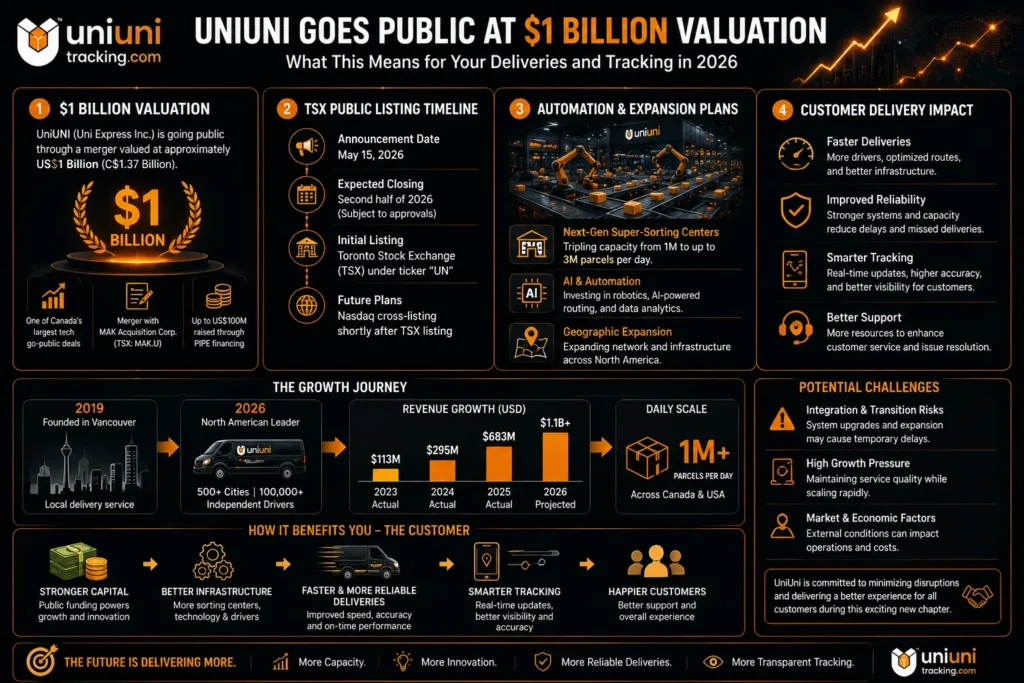
As of this writing the deal hasn’t closed yet — UniUni filed its preliminary prospectus in June and the transaction is still expected to complete in the second half of 2026, after which shares are set to trade on the TSX under the ticker “UN,” with a Nasdaq cross-listing planned to follow. None of that changes anything about how your package gets delivered tomorrow, but it does explain why UniUni suddenly shows up in business news alongside household names, despite most shoppers never having heard of it until a tracking number showed up in their inbox.
In March 2026, UniUni brought on Ali Irturk — previously CTO at Rithum, a commerce platform serving more than 40,000 brands — as its Chief Technology & Product Officer, specifically to push automation and AI deeper into routing and warehouse operations. The company has also grown by acquisition: it picked up Toronto-based logistics firm Shippie in early 2025 as part of its cross-border and tech-integration push.
One naming wrinkle worth clearing up now, since it generates a steady trickle of confused searches: “Uni Express Inc.” is the legal corporate name; “UniUni” is the public brand name used on the website, the app, and every tracking number; “Uni Express” and “UniUni Express” show up interchangeably in older press coverage and some shipping-label templates. All three refer to the same company. None of them are related to “Unishippers” (a separate US freight-brokerage franchise), “UniCarriers” (a forklift manufacturer), or a bubble-tea chain that happens to share letters with the brand name — all real businesses that occasionally get confused with UniUni in search results, for reasons that have nothing to do with each other.
The business model itself is worth understanding because it explains almost everything people find frustrating about the delivery experience. A traditional carrier like UPS or FedEx employs its drivers directly, runs fixed routes, and can enforce consistent training and accountability because the people behind the wheel are on payroll. UniUni’s entire cost advantage comes from doing the opposite: it doesn’t own a fleet or employ its drivers. Instead, independent contractors sign up, use their own vehicles, and get paid per delivery through an app that assigns routes algorithmically. That structure is dramatically cheaper to run at scale, which is exactly why budget e-commerce platforms gravitate toward it — but it also means driver quality, training, and accountability vary far more than they would at a traditional carrier, because UniUni doesn’t control the driver the way an employer controls an employee. That single structural fact is the through-line connecting almost every complaint on the reviews section below, from missed attempts to inconsistent proof-of-delivery photos.
None of that history explains why your specific package is stuck in “Gateway Transit,” and that’s fine — that’s what the rest of this page is for.
→ Full company profile, funding history, leadership, and the IPO explained in plain English: What Is UniUni?
UniUni Tracking: How It Actually Works
If you’re here because a tracking number showed up with no context, this is your starting point. UniUni tracking numbers typically start with “UUS” followed by a string of digits, or occasionally “UNIA” — a related but distinct prefix used on some cross-border and consolidated shipments, and “UUSC” shows up specifically on certain Canada-bound cross-border lanes. None of these are typos or scam indicators; they’re just UniUni’s own numbering system, and they’re often the only clue a shopper gets that UniUni is involved at all, since most retailers don’t name the last-mile carrier at checkout.
Once your package enters UniUni’s network, it typically passes through a sequence of scan events: received at a sorting facility, “Gateway Transit In” (arrived at an interfacility hub), a period of “Interfacility Transited” while it moves between hubs, “Gateway Transit Out” (left that hub for the next leg), then eventually “Out for Delivery” and “Delivered.” Each of those has a plain-English meaning that isn’t obvious from the label alone, and each has its own dedicated guide on this site, because “why has my package said the same thing for three days” is one of the most common things people search for the moment they see one of these statuses and nothing else.
Tracking not updating for a day or two is usually not a lost package — it’s more often a package sitting in a batch waiting for its next scan event, especially over weekends or around statutory holidays when fewer trucks are moving between hubs. It becomes worth investigating specifically when a status hasn’t changed in five or more days, or when “Delivered” appears and nothing is actually at your door.
Here’s the plain-English version of the statuses that generate the most confused searches:
Status on your tracking page | What it actually means |
|---|---|
Gateway Transit In | Package has arrived at a UniUni interfacility hub |
Interfacility Transited | Package is physically moving between two hubs — often the longest-looking “gap” in tracking |
Gateway Transit Out | Package has left that hub, headed toward the next one or toward final delivery |
Out for Delivery | A driver has the package and is actively on route — can still mean anywhere from 1 to 10 hours before arrival |
Sorry We Missed You | A delivery attempt was made and failed — check for a notice left at your door and any redelivery instructions |
Delivered | A scan (and usually a photo) was logged at the destination — worth checking the photo before assuming anything went wrong |
→ Full tracking number formats, status-by-status breakdown, and what to do when tracking stalls: UniUni Package Tracking Guide
Delivery: Timelines, Hours, and What Happens When It Fails
UniUni delivers seven days a week in most of its coverage areas, including weekends — which surprises people used to carriers that don’t run Saturday or Sunday routes, but it’s one of the ways UniUni keeps costs down for the e-commerce platforms that use it. Delivery windows typically run through the evening, later than most traditional carriers, which is why “Out for Delivery” at 4 p.m. doesn’t mean something went wrong if the package doesn’t show up until closer to 8 or 9.
The part that generates the most anxious searches is what happens after a failed delivery attempt. Per UniUni’s own current policy, if a first attempt fails, a second attempt happens within about 48 hours — no action needed on your end unless your delivery details were wrong. If the second attempt also fails, the package goes back to a UniUni warehouse and its status changes to something indicating storage; from there, it’s your move to contact support and arrange redelivery. Packages sit in that storage state for up to 30 days before UniUni considers the delivery abandoned — after that, expect it to be returned to the sender rather than held indefinitely. That 30-day window is worth knowing early, because it’s the deadline that actually matters if your package gets stuck at this stage.
→ Full delivery-hours breakdown, weekend policy, and the complete failed-delivery-attempt process: UniUni Delivery Guide
Customer Service: What Actually Works (And What Doesn’t Anymore)
This is the section most worth reading carefully if you’re mid-crisis right now, because the honest answer here has changed recently and a lot of what’s floating around the internet — including, previously, some of our own pages — is out of date.

For a stretch of 2025 and early 2026, UniUni did publish regional phone support lines. As of UniUni’s own current support page, that’s no longer the case: support today runs exclusively through the chatbot on UniUni’s support page, a searchable FAQ, and the tracking portal itself, which shows proof-of-delivery photos when available. There is currently no published customer service phone number for UniUni, in the US or Canada. If you find a number claiming to be UniUni’s verified support line anywhere online — including, previously, on parts of this site — treat it as outdated at best.
The chatbot is genuinely the fastest real path to a resolution right now, particularly for the two most common issues: a package marked “delivered” that never arrived, and an address or delivery-instruction correction that needs to reach a driver before their next attempt. Have your tracking number ready before you start the conversation — it’s the first thing you’ll be asked for, and having it up front skips a step. For anything the chatbot can’t resolve, it’s designed to escalate to a live agent rather than dead-end you, which is a meaningfully better setup than a phone tree that puts you on hold with no queue position.
A few things worth knowing before you open the chat: address and delivery-instruction updates submitted while a package is already “Out for Delivery” may not reach the driver in time for that specific attempt — the instructions apply going forward, not retroactively. Feedback about a specific driver’s conduct (an unsafe drop, a damaged package, a missed instruction) can be submitted through the same chatbot and does get logged, even though it won’t produce an instant resolution. And if your issue is actually about what’s inside the box — wrong item, missing item, damaged contents — that’s not something UniUni can resolve at all, since it isn’t the seller; that one goes back to the merchant or platform you ordered from, covered in the returns section below.
→ Full walkthrough of the chatbot process, what information to have ready, and how to escalate a stuck case: UniUni Customer Service
Shipping: What UniUni Actually Moves, and For Whom
UniUni’s core business is business-to-consumer parcel delivery for e-commerce platforms, not general freight or postal mail — it doesn’t deliver to PO boxes, and it can’t accept a shipment the way USPS or a private carrier’s retail counter can. Its customer base leans heavily toward large cross-border e-commerce operations: Temu and Shein in particular route enormous volumes of US-bound orders from overseas fulfillment centers through UniUni’s network for the final domestic leg, which is a big part of why UniUni’s name shows up on so many orders from those platforms specifically.
Cross-border handling is one of UniUni’s more technical strengths — the acquisition of Shippie in 2025 was specifically aimed at strengthening customs and cross-border logistics tech, and it shows up in how UniUni handles the international-to-domestic handoff that trips up a lot of smaller carriers. For everyday shoppers this mostly matters in one way: a package that shows international movement, then a UniUni scan, then domestic delivery scans, isn’t bouncing between unrelated companies — that’s the intended cross-border workflow doing its job.
None of this is something you, as the person receiving the package, ever pay for directly or choose — the shipping arrangement and its cost are negotiated between UniUni and the platform or seller, baked into the price (or “free shipping”) you saw at checkout. That’s worth knowing mainly because it explains why there’s no UniUni account to log into, no shipping tier to upgrade, and no way to request a faster UniUni-specific service on an order that’s already placed — any of that has to go through the seller or platform, not UniUni directly.
→ Full breakdown of UniUni’s shipping network, cross-border handling, and coverage: UniUni Shipping Services
Warehouses & Locations: Where UniUni Actually Operates
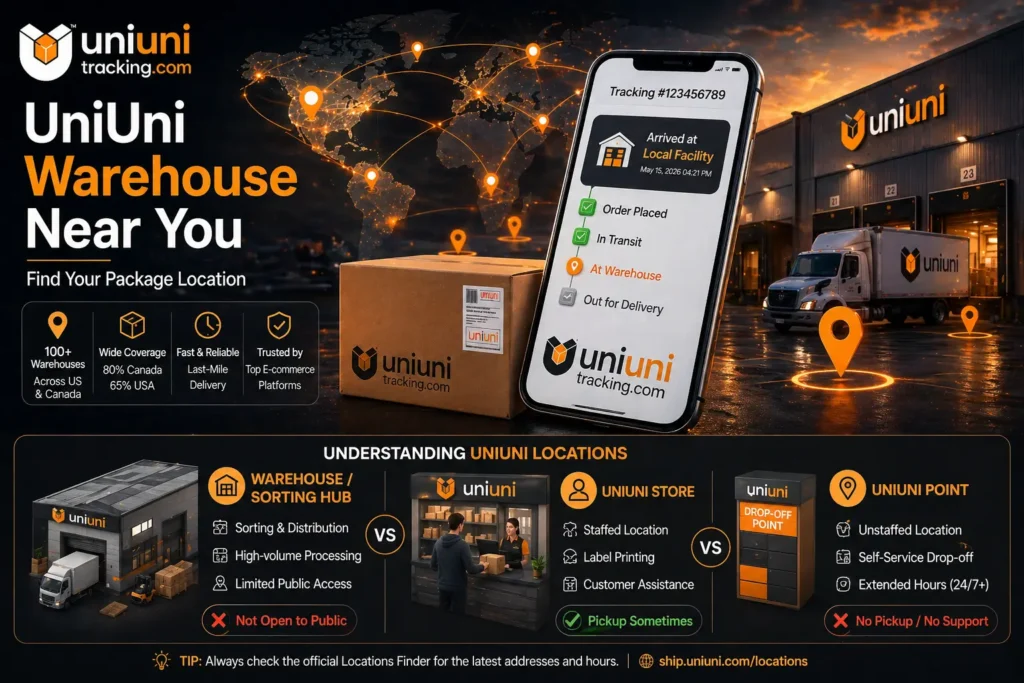
UniUni runs sorting facilities and warehouses across both the US and Canada to support that network, concentrated around major metro areas on both coasts and through central Canada. If a status update mentions a specific facility or city and you’re trying to figure out whether that’s normal for your route, or whether your package is now farther from you than it was yesterday, the locations page breaks down where UniUni actually operates and what a facility name in your tracking history typically means for your delivery timeline.
Coverage is heaviest around the metro areas you’d expect for a company headquartered in Richmond, BC: strong presence across British Columbia and into Alberta, a significant Ontario and Quebec footprint covering the Toronto and Montreal corridors, and on the US side, concentrated coverage across major West Coast metros extending into the central and eastern US as the network has grown. Coverage in any specific city changes as UniUni adds facilities, which is part of why a route that looked unusual six months ago may be completely standard now.
→ Full facility and coverage-area breakdown by city and region: UniUni Warehouses & Locations
Is UniUni Legit? What the Reviews Actually Say
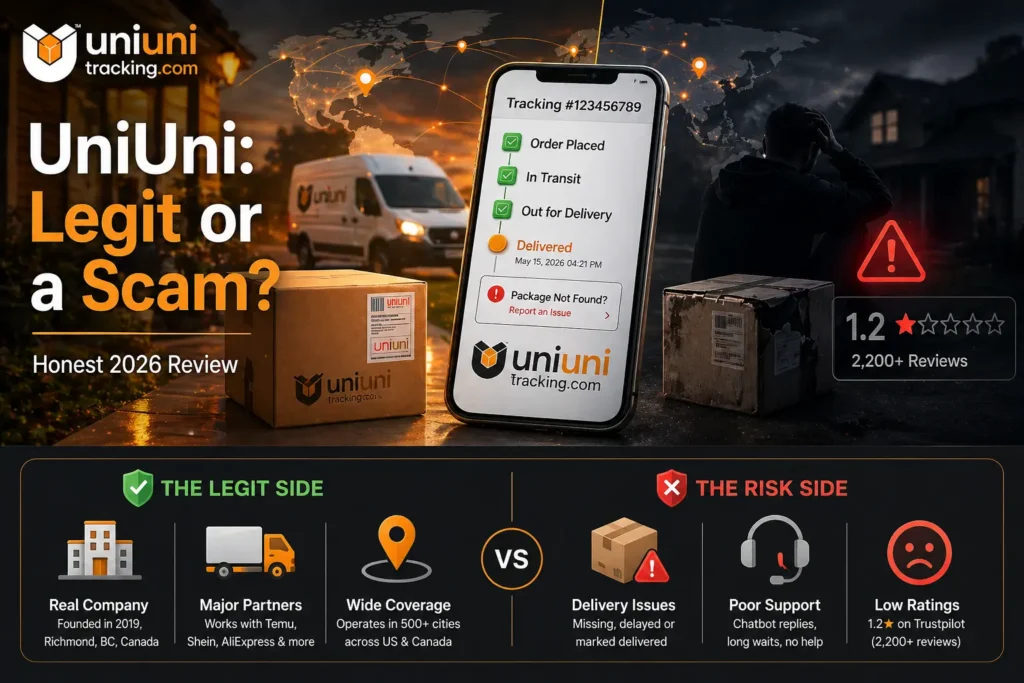
Short answer: legitimate as a company, rough as a delivery experience for a meaningful share of shoppers — and the data backs up both halves of that at once. On Trustpilot, UniUni currently sits at roughly 1.1 out of 5 stars from more than 2,700 reviews, and the Better Business Bureau lists it as an accredited business with an A rating carrying well over 1,600 complaints. Those are not numbers a scam operation generates — a fraudulent business doesn’t have a BBB accreditation, an office you can locate, or a pending stock-exchange listing with audited financials attached. What those numbers do reflect is a real, common pattern in gig-driver-based last-mile delivery: packages marked “delivered” from a spot the recipient can’t find, missed attempts that the tracking log doesn’t fully explain, and customer service that — until recently — was hard to reach and, for a stretch, gave people phone numbers that no longer connect to anything current.
None of that makes UniUni fraudulent. It makes it a low-cost, high-volume carrier operating at a scale where quality control is genuinely difficult, which is a different problem than a scam, even though it produces a lot of the same frustration. If your package is legitimately missing, the fastest real path is UniUni’s own chatbot, followed by the platform you ordered from (Temu, Shein, etc.), which can usually escalate or refund faster than waiting on a carrier-side investigation.
Platform | Rating | Volume | Most common theme |
|---|---|---|---|
Trustpilot | ~1.1 / 5 | 2,700+ reviews | Non-delivery, “delivered” scans with no package present |
BBB | A rating (accredited) | 1,600+ complaints | Failed attempts, difficulty reaching support |
Worth sitting with for a second: a company can carry an A rating from the BBB — which reflects how a business responds to and resolves formally filed complaints — while still averaging near the bottom of Trustpilot’s scale, which reflects raw customer sentiment regardless of resolution. Both things are true of UniUni at once, and neither one cancels the other out. It’s a company that generally does respond when a complaint is formally escalated, operating a delivery model that generates a lot of complaints in the first place.
→ Full ratings breakdown by platform, complaint themes, and the scam-vs-legitimate question answered in depth: UniUni Reviews
Returns & Refunds: A Word of Caution
Here’s something worth knowing before you go looking: UniUni doesn’t handle returns or refunds directly, because it isn’t the seller — it’s the delivery carrier. If an item arrives damaged, wrong, or not at all, UniUni’s own support explicitly directs you back to the merchant or platform you ordered from for anything related to the contents of your package, refunds, or returns. UniUni’s role stops at getting the package to your door (or, per the process above, into a documented failed-attempt or storage status if it can’t).
→ What UniUni can and can’t help with, and how to route a returns issue correctly: UniUni Returns & Refunds
Driving for UniUni & Careers
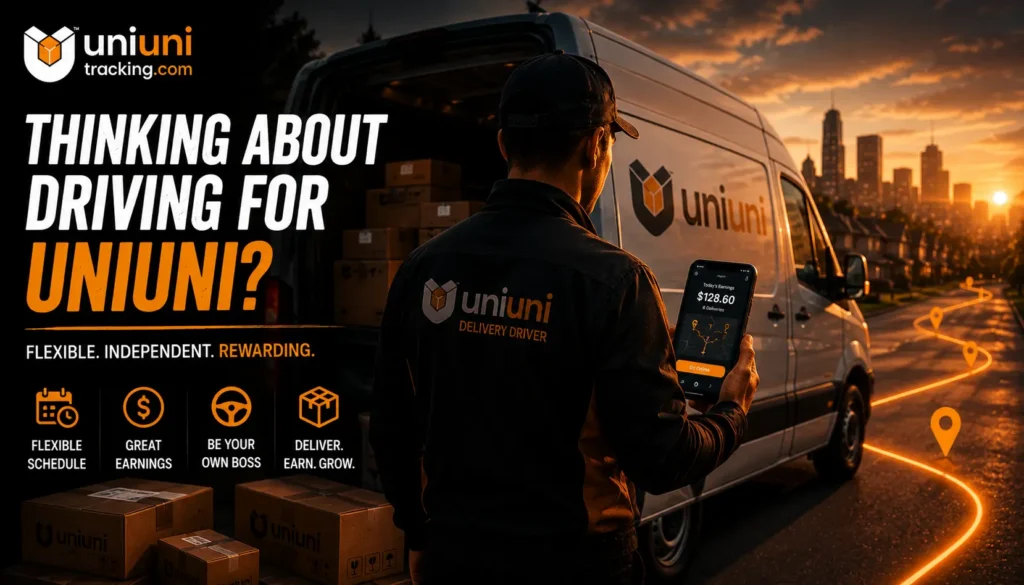
UniUni’s delivery model runs almost entirely on independent contractor drivers rather than employees — that’s the “gig” part of its cost structure, and it’s a genuinely different arrangement from a traditional employed driver at a carrier like UPS or FedEx, with different pay structure, flexibility, and vehicle requirements.
If you’re considering driving for UniUni or looking at other roles at the company, the careers page breaks down what the application and onboarding process actually looks like, based on what’s publicly documented rather than any specific current job posting, since postings change constantly and any list of “current openings” goes stale within weeks.
→ Full breakdown of the driver application process, requirements, and other UniUni roles: UniUni Jobs & Careers
Tracking Tools & the UniUni App
Beyond this site’s own tracking tool, UniUni operates its own tracking page and a driver-facing mobile app; there are also a handful of third-party tracking aggregators that claim to track UniUni shipments. The tools page compares what each option actually shows you, since not every tracker pulls the same level of scan detail, and some lag noticeably behind UniUni’s own live data.
→ Full comparison of official vs. third-party UniUni tracking tools: UniUni Tracking App & Tools
Company News: The IPO, and What’s Actually Changing
Two things are happening to UniUni at once right now, and it’s worth keeping them separate. The first is operational: the company keeps growing, adding automation, and expanding coverage, which is why service and coverage details on this site get revisited regularly rather than treated as fixed. The second is financial: the pending merger with MAK Acquisition Corp. and pursuit of a public listing on the TSX, which is a corporate and investor story, not a change to how your package gets delivered tomorrow. Going public typically brings more disclosure requirements and investor scrutiny, which over time tends to push companies toward more consistent operations — but that’s a multi-year trend at best, not something that shows up in this week’s delivery experience.
Separately, UniUni has also been named in ongoing litigation involving a business dispute with a partner company over withheld parcel volume — a corporate legal matter, not something that affects individual shoppers’ packages or their ability to get a delivery resolved through the chatbot above. We track the latest developments in that case in our company news coverage, updated as filings and developments occur.
→ Full IPO timeline and company news archive: UniUni Company News
The 8 UniUni Questions You’re Actually Asking Right Now
The Bottom Line
UniUni isn’t a scam, and it isn’t going away — it’s a fast-growing, soon-to-be-public logistics company that most of its own end customers have never directly chosen and don’t fully understand, which is exactly the gap this site is built to close. Whatever brought you here today — a stuck tracking number, a missed delivery, a number that doesn’t work anymore, or just a name you didn’t recognize on a package — there’s a dedicated page above built to answer it in more depth than a single homepage section can. Start with the tracking tool at the top of this page, or jump into whichever section above matches your actual situation.
This site is independently run and has no affiliation, partnership, or endorsement relationship with Uni Express Inc. or UniUni. All trademarks belong to their respective owners.